What Would You Say?

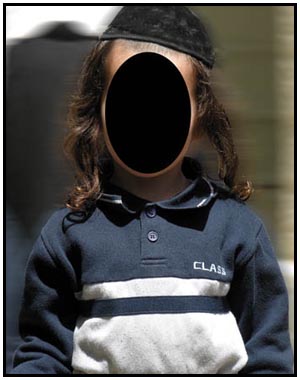
What would you say if this 10 year-old boy told you “[bad] things happen to you because you don’t wear a kipa (a.k.a. yarmulke or skullcap) and eat kosher food”? That’s what happened to me.

I had occasion to be at his school and he befriended me while I was waiting for his principal. His school is a private, religious, elementary school with an enrollment of about 80.

To say that I was the odd man out would be a dramatic understatement. Although I made a special effort to dress in long pants and a hat before going there, I was clearly the outsider, with no chance of ever fitting in. However, he was friendly and conversational. The other kids mostly stared at me, much like I do a strange fish featured on the National Geographic Channel.

He told me that his class had just finished studying the book of Joshua, so I asked him to give me the short story version of Joshua. He started regaling me with a Midrashic story of Joshua beating up three thieves. He enjoyed doing karate chops and shadow punches as he mimicked Joshua’s clear and overwhelming victory over the bad guys. I enjoyed seeing his excitement, though I was disappointed that he didn’t include anything about Joshua from the Bible in his summary.

During our conversation, it was clear that, in spite of his willingness to engage me in conversation, he, like the rest of his classmates, viewed me as an outsider, too. I didn’t look like him, therefore, it was obvious that I didn’t eat like him either. His comments revealed that the two criteria he used to determine my standing before HaShem (God) were my dress (especially the type of head covering) and my food.

He was surprised to find out that we actually buy kosher food. (It’s not so hard in Israel. In fact, it is more difficult to buy non-kosher food here.) However, it only took him one more question to reveal that we don’t “really” buy kosher food: we don’t buy food authorized as kosher by his particular group. “If it isn’t [a particular kosher stamp], it is not really kosher. They just trick people like you with all the other kosher stamps,” he said with complete assurance.

Though the hat I had chosen to wear allows me entrance to the Western Wall in Jerusalem, it wasn’t an approved head cover in his world. After all, it wasn’t a black kipa like he wears. However, there is still hope for me: If I stop eating non-kosher food and wear a black kipa, bad things will stop happening to me.

While I wouldn’t expect a ten year-old to see the irony of this conversation, I didn’t miss it. When I asked him how many brothers and sisters he has, he said, “I have three sisters, but I only say two because the youngest [an infant] is about to go to heaven.” (I found out later that his youngest sister has a serious heart problem and he has 4 brothers.) The problems I was there to speak with the principal about weren’t even on the “problem scale” compared to the death of an infant.

It never occurred to him that the proper head cover and kosher stamp hadn’t prevented bad things from happening to his family. The only thing he could clearly see is that I was an outsider invading his world, which must be the reason for my problems.

Questions:
1. How would you respond to his conclusions? Would you challenge him or simply not accede to his position?
2. How would you offer him encouragement and hope regarding his sister’s health condition?
3. How would you share the gospel with him?

Don’t Be All Nice!

2 Timothy 2:24-26 – And a sevant of the Lord must not quarrel but be gentle to all, able to teach, patient, in humility correcting those who are in opposition, if God perhaps will grant them repentance, so that they may know the truth, and that they may come to their senses and escape the snare of the devil, having been taken captive by him; to do his will.

Once I received a call to help distribute New Testaments to convention goers in Tel Aviv. By God’s grace, “we” were able to distribute a couple hundred New Testaments (at least twice that many the previous night) before the professional anti-missionaries arrived. Still, before the pros got on the scene, we had a number of “negative” encounters with people who were angry about our activities.

One encounter, in particular, was with one of the civilian security guards. He was screaming all the usual things at one of the members of our group: “Get out of here with your foreign stuff! This is the Holy Land, land of the Jews not Christians. What you’re doing is illegal. I’m going to call the police.”

I usually learn something on these outings and God was generous to me once again. As I watched this encounter between “our guy” and the angry, armed-guard I noted a few things:

First, “our guy” spoke to the angry man in Hebrew, but the angry man always responded in English. Not because he couldn’t speak Hebrew, but rather to try to persuade the on-lookers that “our guy” was bringing a foreign religion to the Jewish people. This was a mostly unsuccessful, but interesting tactic for sure.

Second, “our guy” never raised his voice or tried to compete with the angry man. He simply smiled and spoke very calmly, responding to each of his complaints. The fact that “our guy” was calm and polite eventually caused the angry man to snap: In desperation, and apparently referring to 2 Tim 2:24, he shouted, “Don’t be all nice!!” “Our guy” simply smiled and walked a few steps away from the angry man.

If those who are vocally (sometimes physically) opposing our efforts are not professionals, they generally give up in frustration if we don’t engage them in loud arguments. Smiling really seems to take the air out of their sails.

At the same event mentioned above, I had a military security guard opposing me. He, too, was frustrated that I never got heated up. After about 20 minutes of unsuccessfully trying to persuade me, he moved to others from our group. He was supposed to be providing security for this event, but he spent about an hour trying to convince us how wrong we were for handing out New Testaments. Finally, in frustration he went and sat in the shade and pouted. Now that was a cute site: a soldier armed with an M16, sitting and pouting like a small child. His spirits lifted, though, when the “professionals” arrived.

Interestingly, it is not uncommon for bystanders who don’t agree with our message to defend our actions. What an interesting sight to see: unbelievers loudly arguing our case with those who oppose us. It seems that the more we smile and stay calm in the midst of being shouted at, the more unbelievers come to our defense.

We are to correct our opponents in a spirit of humility (2 Tim 2:25). Clearly, this is easier said than done. The flesh, my flesh, screams for the opportunity to send a zinger back at people who are saying all manner of filthy things against me and Jesus. (Grammatically the order of “me and Jesus” is wrong, I know, but I wanted to be accurate in portraying how the flesh sees things: ME first.) However, God desires, even demands that we respond to our opponents in humility.

The answer to this dilemma is found in Galatians 5:16-17: “I say then: Walk in the Spirit, and you shall not fulfill the lust of the flesh. For the flesh lusts against the Spirit, and the Spirit against the flesh; and these are contrary to one another, so that you do not do the things that you wish.”

Our objective in humbly correcting our opponents is to see them repent (2 Tim 2:25-26). Please note, however, that it is not us who brings them to repentance, but God who grants repentance. This is God’s work and he desires to use humble tools to accomplish His work. The emphasis should not be on our labor/efforts, but on God’s grace in bringing a sinner to repentance. Often, however, during large outreach efforts, one can hear “our guys” standing around conversing about the labor instead of God’s grace. Perhaps this is a sign that we are not as humble as we should be.

We must keep in mind that the “bad guys” are ensnared by the devil and are being held captive by him to do his will (2 Tim 2:26). And he clearly hates the distribution of God’s word/truth in any form. This is a spiritual battle.