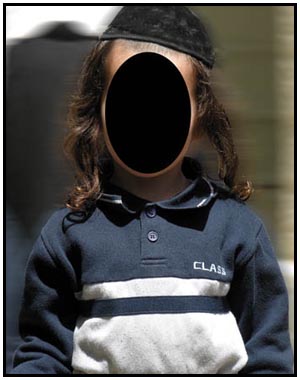
 What would you say if this 10 year-old boy told you “[bad] things happen to you because you don’t wear a kipa (a.k.a. yarmulke or skullcap) and eat kosher food”? That’s what happened to me.
I had occasion to be at his school and he befriended me while I was waiting for his principal. His school is a private, religious, elementary school with an enrollment of about 80.
To say that I was the odd man out would be a dramatic understatement. Although I made a special effort to dress in long pants and a hat before going there, I was clearly the outsider, with no chance of ever fitting in. However, he was friendly and conversational. The other kids mostly stared at me, much like I do a strange fish featured on the National Geographic Channel.
He told me that his class had just finished studying the book of Joshua, so I asked him to give me the short story version of Joshua. He started regaling me with a Midrashic story of Joshua beating up three thieves. He enjoyed doing karate chops and shadow punches as he mimicked Joshua’s clear and overwhelming victory over the bad guys. I enjoyed seeing his excitement, though I was disappointed that he didn’t include anything about Joshua from the Bible in his summary.
During our conversation, it was clear that, in spite of his willingness to engage me in conversation, he, like the rest of his classmates, viewed me as an outsider, too. I didn’t look like him, therefore, it was obvious that I didn’t eat like him either. His comments revealed that the two criteria he used to determine my standing before HaShem (God) were my dress (especially the type of head covering) and my food.
He was surprised to find out that we actually buy kosher food. (It’s not so hard in Israel. In fact, it is more difficult to buy non-kosher food here.) However, it only took him one more question to reveal that we don’t “really” buy kosher food: we don’t buy food authorized as kosher by his particular group. “If it isn’t [a particular kosher stamp], it is not really kosher. They just trick people like you with all the other kosher stamps,” he said with complete assurance.
Though the hat I had chosen to wear allows me entrance to the Western Wall in Jerusalem, it wasn’t an approved head cover in his world. After all, it wasn’t a black kipa like he wears. However, there is still hope for me: If I stop eating non-kosher food and wear a black kipa, bad things will stop happening to me.
While I wouldn’t expect a ten year-old to see the irony of this conversation, I didn’t miss it. When I asked him how many brothers and sisters he has, he said, “I have three sisters, but I only say two because the youngest [an infant] is about to go to heaven.” (I found out later that his youngest sister has a serious heart problem and he has 4 brothers.) The problems I was there to speak with the principal about weren’t even on the “problem scale” compared to the death of an infant.
It never occurred to him that the proper head cover and kosher stamp hadn’t prevented bad things from happening to his family. The only thing he could clearly see is that I was an outsider invading his world, which must be the reason for my problems.
Questions:
1. How would you respond to his conclusions? Would you challenge him or simply not accede to his position?
2. How would you offer him encouragement and hope regarding his sister’s health condition?
3. How would you share the gospel with him?


Scary Quote
Background: Due to a recent public sector labor strike, workers at Israel’s Ben Gurion airport refused to process passengers and aircraft coming or going. This work stoppage caused a tremendous backup that stranded passengers from all airlines.
Once the strike ended, all the airlines, including El Al, Israel’s recently privatized, national carrier, worked overtime on Shabbat (Sabbath) to get their stranded passengers to their destinations. El Al’s “desecration” of the Sabbath has stirred quite a controversy in Israel, particularly but not exclusively among religious Jews.
On Monday, following the perceived Sabbath desecration, a New York bound El Al aircraft had to return to Ben Gurion Airport due to a landing gear malfunction and some (perhaps, many) among the religiously observant community saw it as a sign that God was displeased with El Al.
Minor Question: Is this any different than Pat Robertson suggesting that Ariel Sharon’s massive stroke demonstrated God’s displeasure with his handling of Gaza and the West Bank?
Real Issue: Is it appropriate to suggest that the Sabbath has such powers? Did God intend for the Sabbath to watch over the nation of Israel? Can it really watch over Israel? It is commonly said that if all Jews would observe the Sabbath two consecutive times, Messiah will present himself. While this is clearly an unbiblical assertion, it is dramatically different than suggesting that the Sabbath has protective power.
Psalm 121
I lift up my eyes to the hills –
where does my help come from?
My help comes from the LORD,
the maker of Heaven and Earth.
He will not let your foot slip –
He who watches over you will not slumber;
Indeed, He who watches over Israel
will neither slumber nor sleep.
The LORD watches over you –
The LORD is your shade at your right hand;
the sun will not harm you by day,
nor the moon by night.
The LORD will keep you from all harm –
He will watch over your life;
the LORD will watch over your coming and going
both now and forevermore.
If I’ve got a choice between trusting the Sabbath and trusting the LORD, I’m going with the LORD every time.
Share this:
Like this: