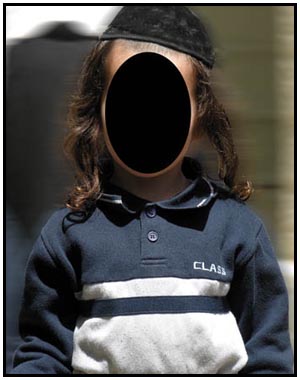
During the Passover holiday, I had an enjoyable and (like always) interesting visit at the Western Wall. Unsurprisingly, there were more people at The Wall than on ordinary days, which is always pleasing to my senses. I really enjoy the hustle and bustle of activity at The Wall during the holidays.
As I sat facing The Wall, I generally tried to lock in on a particular area and wait patiently for a good photo-op to present itself. This approach generally draws the attention of the more religious and creates a situation of them watching me watch them. Almost a standoff to see who will reveal their interest in the other first. Who is more interested in what the other is doing, me or them?
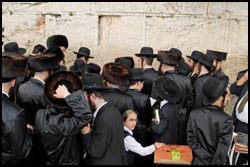 Due to the personal nature of prayer, even at a large public venue, I try to be discreet in taking photographs at The Wall. I realize that some people don’t want their picture taken at all, while others, for the sake of public appearance, pretend to not want their pictures taken. Others don’t mind at all, and sometimes even ask to have their picture taken. I ran into such a situation on my last photo shoot at The Wall: some wanted me to take pictures, others didn’t.
I’m naturally a people watcher. And, since I was scouting for good photo opportunities, my senses were extra sharp. I was sitting, facing the wall, so I couldn’t see what was happening behind me, but from certain movements among the Haredi (ultra-orthodox) guys at the wall, I could tell something big was developing. I could see men “nonchalantly” relocating. Some were moving chairs and tables and children as if to make room for a group of guests. And the crowd in this particular area of the The Wall was starting to grow in number and anxiety.
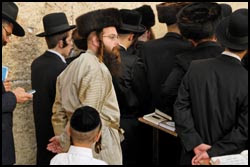 Suddenly from behind me on the right a wave of men dressed in the standard issue black and white uniform flowed toward The Wall in a way I had never seen before. In the front of that wave of people was an elderly man whom I could tell was the reason for the crowd and the anxiety. The crowd that was already at The Wall opened up to allow this apparently holy man to approach The Wall in the way I envision the Red Sea opening up to allow Moses and the children of Israel to pass. As soon as I saw the wave of people moving in from my right, I got to my feet and tried to position myself for some good shots of whatever it was that was happening. But I was too late because just as quickly as the wall of people opened, it closed, and the special guest was sealed inside, safely within the admiration of his followers and protected from people like me.
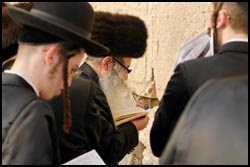 The crowd continued to swell as word of the man’s arrival spread. I could feel myself being pushed further and further away from the guest of honor, but I was determined to find an open view of that man, whoever he was. I moved around the mob, first left, then right, looking for a view. Finally, on the far right, I was able to weave my way in front of some of the more timid onlookers and see him, face close to the wall, prayer book in hand, moving back and forth as he prayed.
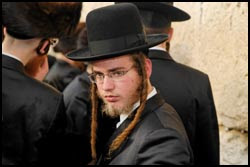 Perhaps the most interesting thing in the whole process, was that a group of teenagers had made their way close to the elderly man and were serving, for lack of a better word, as his posse. It seemed that their responsibility was to keep people like me at a distance, or at least block my view. And once they saw me raise my camera, they went into action. They never approached me, they simply crowded together in a way that blocked my view. Well, most of the time. They were in a dilemma: should they give more attention to me, or to praying with their leader? So, as they bobbed back and forth in prayer, occasionally looking back over their shoulders as a warning to me, they occasionally gave me clear views of The Man.
After I had taken all the shots I wanted, I went and sat down where I was sitting when the wave of people appeared earlier. Apparently, a number of The Man’s followers had noticed my efforts to get his photograph because several were now focused on me. After a few moments, one of them approached me and politely explained to me how improper it was for me “to take photographs of such a holy man.” I asked for The Man’s name, but he only said, “this is a different world from yours. He is a revered teacher and it isn’t nice to take his picture, so don’t take any more pictures.”
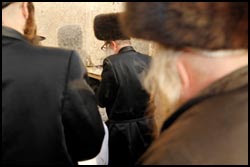 As I sat thinking about that brief conversation, another of the “Holy Man’s” admirers approached me. However, unlike the previous fan of The Man, with a big smile on his face the second man asked, “Did you get some good pictures of him?” “Yes,” I answered. “Do you know who He is?” “No, perhaps you can tell me,” I offered. “He’s a very famous teacher. Do you think you got some good pictures?” “Yes,” I assured him. “Well, if you got some good pictures, would you send me a couple? You should try to get some more. Try from the other side and send those to me, too.” I entered my phone number in his mobile phone so that he could give me an address because neither of us had a pen or paper. He seemed really happy at the prospects of getting some photos of the “Holy Man” praying at The Wall at Passover. However, he never called. So, I guess if he reads this, he can see some of the photos he missed.