Isaac or Ishmael?

Eid al-Adha, sometimes called the Festival of Sacrifice is an important festival for Muslims around the world. It occurs in connection with the yearly pilgrimage to Mecca, serving as the conclusion to the (at least once in a lifetime) required journey for all Muslims.

The point of the festival is to remember and commemorate the trials and triumphs of the Prophet Abraham. Some suggest that Eid al-Adha is the most important festival in Islam because God’s command to Abraham to sacrifice his son, who was ultimately replaced by a ram, was Abraham’s greatest trial and triumph. Abraham obediently took his son, placing him on the altar (Qur’an: on his forehead) and as he raised the knife, the angel directed him to replace his son with a ram that was nearby.

Whether the Festival of Sacrifice is the most important or not, the symbolism demonstrated in the festival activities is quite powerful. For me, the most memorable activity of the festival is the sacrificing of animals: camels, goats or sheep. And this might be the most memorable for many. In fact, for some 1400 people in Turkey this year, the sacrifice will be the most memorable part because they all ended up in the hospital emergency room as a result of wounding themselves in the process.

Sometime last year while preparing for a lecture on Islam that I was to give, I was reading the Qur’an and stumbled upon a very interesting (to me) discovery. I was reading Surah 37, as-Saffat, when I came upon the detailed story of Abraham sacrificing his son, which was mixed in with stories of several prophets, eight to be exact.

The names of those prophets named in Surah as-Saffat are: Noah, Abraham, Isaac, Moses, Aaron, Elias, Lot, and Jonah. You will see that Ishmael’s name is missing. Why is this important? Because Muslims, during the Festival of Sacrifice, are commemorating the near sacrifice of Abraham’s son Ishmael, not Isaac as the Bible teaches. When I discovered the absence of Ishmael’s name, it was one of those explosive moments when one thinks, “I can’t be reading this right.” That being the case, I re-read the passage and Ishmael’s name was still absent. Then, I got a pencil and re-read the chapter, writing down the list of people named in as-Saffat. And, my first reading was still correct: Ishmael isn’t named. In fact, he isn’t named as (almost) being sacrificed anywhere in the Qur’an.

This has surprised every Muslim I have asked about it. Usually, the encounter goes something like this:

Me: Does the Qur’an say that Abraham attempted to sacrifice Ishmael?
Them: Yes.
Me: Do you know where it is written that Ishmael is the object of sacrifice?
Them: It must be in Surah Ibrahim. Let me find it. Hmmm, it’s not here.
Me: Perhaps you can look at Surah as-Saffat.
Them: Yes, here’s the story. Here it tells about Ibrahim who went to sacrifice his son.
Me: Does it say Ishmael there?
Them: Well…his name isn’t here, but it’s him. It must be written somewhere else. Let me look for it.
Me: I’m sure you will not find it because it isn’t there. Does it bother you that Ishmael’s name isn’t actually mentioned in a story so important to Islam?
Them: Well, I’m sure it’s somewhere else in the Qur’an.
Me: But it’s not.
Them: It must be…

It isn’t and I find that very interesting. Especially since one of the main places Muslims say the Bible has been corrupted is here, where Abraham agrees to sacrifice his son. The Bible says that son was Isaac, Islam disputes that. But the Qur’an doesn’t specifically name Ishmael within the story itself. I wonder why?

One gentleman that I spoke with asked his imam to call me and answer my question. When I posed the question to the imam, he said that I was correct: Ishmael’s name isn’t found in the Qur’anic version of this story. The understanding that Ishmael was the intended sacrifice is Islamic tradition, which is binding upon Muslims to believe. Therefore, all Muslims believe that even though not specifically named, Ishmael was the son whom Ibrahim prepared for sacrifice.

My question: What happens when tradition seems to go against the text? “Which is more authoritative,” I asked the imam. His answer: “Neither. It doesn’t work like that in Islam. The Qur’an is the Qur’an and the Tradition is the Tradition. They go together.”

For those wondering: NO, I wouldn’t embrace the Qur’anic version of this story if Ishmael’s name were specifically mentioned. I fully believe the Bible’s version and simply use this “irony” as a conversation starter with Muslims.

A Personal Psalm

Following is a personal psalm that I wrote ten years ago for the occasion of my ordination. It is based on the model of Psalm 136 and served as a wonderful opportunity to identify and proclaim the many ways that God has worked in my life. I commend the exercise to you for your personal edification.

A Psalm of Thanks

O give thanks unto the Lord; for he is good: for His mercy endures forever.
O give thanks unto the God of gods; for he is good: for His mercy endures forever.
O give thanks to the Lord of lords: for His mercy endures forever.

To Him who alone doeth great wonders: for His mercy endures forever.

To Him who has given me loving parents: for His mercy endures forever:
Who have always been supportive even when they didn’t understand the direction of my life: His mercy endures forever.

To Him who gave me someone who would become a “best friend”: His mercy endures forever:
Who first invited me to church: His mercy endures forever:
And expressed a concern for my soul: His mercy endures forever.

To Him who sent a preacher with the message of salvation: His mercy endures forever:
Who preached with passion and love: His mercy endures forever:
And clearly communicated to me salvation in Christ: His mercy endures forever.

To Him who gave me men and women who would train me in godliness: His mercy endures forever:
Who opened the Holy Scriptures to me: His mercy endures forever:
And guided me in wisdom: His mercy endures forever.

To Him who allowed me to live in Zion: His mercy endures forever:
And gave me a family and ministry in the Holy City, Jerusalem: His mercy endures forever:
And set within my heart a love for his people, Israel: His mercy endures forever.

To Him who shall sustain me through trials and temptations: His mercy endures forever:
When the tempest shall rage about me, He is sure: His mercy endures forever:
When burdens are heavy, He is strong: His mercy endures forever:
Though darkness may encompass me, He giveth light: His mercy endures forever.

To Him who now sends me out by the laying on of hands: His mercy endures forever.

O give thanks unto the God of heaven: for His mercy endures forever.

Modeled after Psalm 136 by Craig Dunning – October 30, 1996

Friday Fotos – This Ain’t Jed Clampett

With the theme song of the Beverly Hillbillies playing in the background, I can say: This isn’t a picture of Jed and family making their way to Californy. Instead, it is me on the way to a festival. As you can see it takes a lot of stuff and a good bit of effort to make an impression at the festivals.

Everybody’s Talking About the Resurrection

Since Sunday, April 16, was Easter Sunday, you might not think my title is strange. Perhaps where you are, everybody is talking about the resurrection. However, here in Israel, even on Easter Sunday, everybody isn’t usually talking about the resurrection, unless, of course, you were one of 10,000 people packed into Tel Aviv’s Nokia Arena on Sunday night.

One of the organizers, Yoni Kahana, happily described the evening as “an amazing turnout.” He went on to say that that “Everyone came away with renewed faith in the imminent coming of [the messiah]. He may not have come on Sunday night. But he will truly be revealed any second.” Wow, ten thousand people gathered together in Tel Aviv, Israel excitedly anticipating the return of the messiah. Now that is something that will even get a Baptist to shout “amen,” maybe even clap.

The interesting twist on this, however, is that on this Easter Sunday they weren’t talking about Jesus’ resurrection and imminent return, they were talking about the (hoped for) resurrection of the late Rabbi “Messiah” Menahem Mendel Schneerson, who died in Brooklyn in June 1994.

MessiahThis kind of resurrection talk isn’t new; it’s just different in that it is open and public. In the years since Schneerson’s death, particularly in the days immediately following, many of his followers proclaimed their belief in his identity as Messiah, but it was almost an “in house” discussion. A discussion that, at times, grew to more than a friendly discussion, which threatened to completely split the Chabad movement.
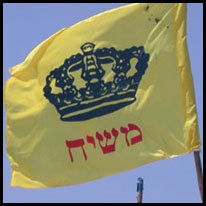
In recent years, though, I have noticed a growing number of posters along the highways proclaiming The Rebbe, as his followers know him, as Messiah. Some are more subtle than others, like the one on the right, for example: On this flag, the word Messiah (in Hebrew) is written under the royal crown. If you don’t have more background information on this campaign, it would be easy to dismiss this as a fervent, religious Jew simply flying his colors.

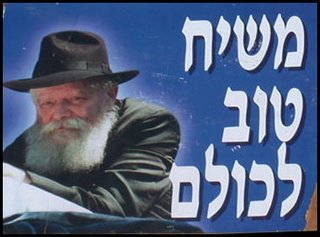
This poster (left), commonly seen all over Israel, King Messiahfits into the less subtle category as it says “King Messiah” under the photo of The Rebbe. I’m not certain that this particular poster was at the convention hall on Sunday night, but the sentiment certainly was. Rabbi Zalman Notik of the Torat Emet Yeshiva in Jerusalem spoke openly of Rabbi Schneerson as the messiah. Furthermore, he supported the missionary zeal for which Chabad has become known when he said, “…the most important mitzvah [commandment] is to publicize the idea that the Rebbe is messiah.” No wonder Chabad is often characterized as the Jewish evangelicals: They believe that Rabbi Schneerson is the messiah and that he is good for everyone, particularly Jews.

A religiously observant, Jewish friend once told me that he didn’t agree with Chabad’s or my desire to tell others about our faith. “I believe” he said “that what I believe is good for me, but not necessarily for everyone else.” I pointed out that that is one major difference between us: I believe that Messiah is not only good for everyone, but necessary. Apparently followers of the Chabad sect of Judaism believe more like I do about messiah in that regard. Our disagreement comes in the identity and function of the messiah, not the desire for others to know about him.

The Messiah is good for everybody.This poster (right) includes with The Rebbe’s photo the words, “Messiah is good for everybody.”

Rabbi Schneerson Quick Facts:
Date of Birth: April18, 1902
Place of Birth: Nikolaiev, Ukraine
Visits to Israel: None
Date of Death: June 12, 1994
Place of Death: New York, USA

Persecution in Israel

Jesus said, “Blessed are ye, when men shall revile you, and persecute you, and shall say all manner of evil against you falsely, for my sake (Matthew 5:11 KJV).”

The latest group who were blessed in this manner in Israel was the Beersheva Congregation. You can see some photos and videos of this orchestrated protest turned assault here. [Update: The link is no longer good.]

The Beersheva and Arad congregations have been particularly targeted over the last couple of years and seem to be growing more vulnerable to such attacks. The police have been fairly ineffective at protecting the congregants in these cases. Thankfully, no one was seriously injured, but it probably will not be long before that changes. Mob violence can get out of hand very quickly, even unexpectedly.

Persecution in Israel is primarily accomplished through social pressure intimidation, and ostracism, but occasionally manifests itself in violence. There is a tremendous amount of social stigma placed upon Jews who believe in Jesus.

Currently, it is legal for Jews to believe in Jesus and promote that belief through many different means, except toward those under 18 years of age. However, over the last eight years there have been a few attempts in Parliament to make it illegal to evangelize at all, or in another case to possess literature that might be used to encourage one to convert. So far, all political attempts to silence Jews who believe in Jesus have failed.

Please pray that the believers in Israel would “Remember the word that I [Jesus] said unto you, The servant is not greater than his lord. If they have persecuted me, they will also persecute you; if they have kept my saying, they will keep yours also. 21But all these things will they do unto you for my name’s sake, because they know not him that sent me (John 15:20-21 KJV).”