Cancer Sniffing Phone App?

Need some good news that will likely have some effect upon you? Then, read on.

One of the many amazing technologies coming forth from Israel’s hotbed of medical technology is a cancer sniffing device that smells cancer on the user’s breath.

By identifying the special “odor” emitted by cancer cells, the NaNose system can detect the presence of tumors, both benign and malignant, more quickly, efficiently and cheaply than previously possible.” – Professor Hossam Haick

Reports are that this device is 90% accurate in detecting the presence of cancer. And it is particularly helpful in detecting lung cancer, which typically doesn’t present recognizable symptoms until it is strongly entrenched in the body.

A news smart phone app will make this technology widely available, and will likely increase the survival rate of those afflicted by cancer.

See an introduction to this amazing technology in the video below.

I learned of this technology from Michael Ordman who uses his blog, Good News from Israel, to highlight, well … good news from Israel. I recommend you visit his blog regularly, or simply sign up for the email distribution of Good News from Israel.

Thankful For My Wife

colleen-blue-bonnets-094I’m thankful for my wife. She is a Proverbs 31 wife:

“A wife of noble character who can find? She is worth far more than rubies. Her husband has full confidence in her and lacks nothing of value. She brings him good, not harm, all the days of her life.”

I am blessed to be married to a woman who loves Jesus deeply; who desires to grow in her faith and walk obediently to the Lord; who desires God’s best for her husband, kids, and friends; and who works endlessly to take care of her family and home.

I was blessed to see her work in the kitchen for two long days to prepare a wonderful spread for our Thanksgiving guests. Everything was not only thoughtfully planned, but thoughtfully prepared.

I lack nothing of value. Thank you, Lord.


Happy Thanksgiving!

This is my all-time favorite “Thanksgiving” photo. We were in Port Angeles, Washington in 2006 and some friends took us to a field that had a flock of wild turkeys. We went into the field and the turkeys took an interest in our 2 1/2-year-old (at the time) daughter, Grace.

grace-turkeys-72dpi-enhanced

ISIS and the Gospel

WARNING: Links in this post may lead to GRAPHIC CONTENT!

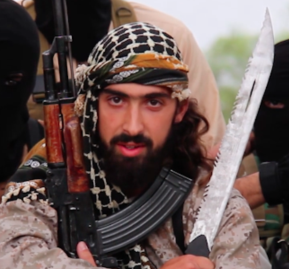
Abu Maryam al-Faransi left France to join ISIS.

Abu Maryam al-Faransi left France to join ISIS.

The news coming from the Islamic State is, at best, unsettling. As a result of effective recruiting, foreign fighters from both Muslim countries and the West are swelling the ranks of the ISIS army (see here, here, and here). In addition to the West’s apparent failure in turning certain of their citizens away from jihadi ideology, or western nations’ apparent failure to prevent these same people from making their way to Syria to join the battle, several elements of the ISIS jihad story lead observers to conclude that the situation in Syria/Iraq is hopeless. Two of those elements are martyrdom and brutality.

Martyrdom: A Desire to Die

“We love dying for God as much as you love life.” ISIS fighter, Rabie Shehada

That they are likely to be killed in the battle to expand the boundaries of the Islamic State doesn’t seem to dissuade the recruits. In fact, the prospect of dying as a martyr for Allah seems to be a draw (see here, here, and here). Targeting this element of jihadi ideology – the desire to die for the cause – recruiters are using social media to publish photos of many of their soldiers who died with smiles on their faces (see here, here, and here), which suggests they died happy martyrs.

With every new conflict comes imaginative new methods to recruit fighters and soldiers on all sides. While the US Military uses high budget television adverts or internet campaigns designed to show off the superiority of their forces, the propaganda wing of the Islamic State has taken to posting and sharing pictures and videos of dying and dead “martyrs”, all smiling. najemoi.com

 Brutality: Glorifying and Defending a Way of Life

The brutality of ISIS – which includes, among other things, hanging captives from their feet, repeated mock executions, extra-judicial mass executions, rape, sexual and physical enslavement, beheading, and the public parading of heads and decapitated bodies – has been widely reported by released hostages (see here, here, and here) and/or confirmed by video, photos, and commentary released through ISIS channels (see here, here, and here).

ISIS has successfully utilized the brutality of their movement to recruit the discontent or wandering souls (both males and females) who seek purpose and meaning in life (see here, here, and video here).

“For many people who are lacking a strong sense of identity and purpose, their violent radical global narrative provides easy answers and solutions: it can be very powerful message for people who are looking for answers,” … “Their online material shows capturing territory, establishing states, beheading enemies: they show that they are the sexiest jihadi group on the block.” Matthew Levitt, Washington Institute for Near East Policy.

Not only has brutality been an effective recruiting tool for ISIS, it is also intended to bring into submission those whom ISIS deems to be enemies. In the Islamic State, submission takes different forms: forced conversion to Islam, evacuation to safer locations (see here and here), or paying a security/protection tax.

Those who are concerned that the gospel be effectively taken to all, have to wonder if it is possible to get the gospel to people within ISIS. And, even if one succeeded in getting it there, is it possible for a person that glories in beheading aid workers, a person that appears to glory in evil, to believe the gospel? My answer: There is hope. Even ISIS fighters and their brides can be reached with the gospel.

Below, I offer two lines of evidence that give me gospel hope for those who are engaged in this type of jihad with ISIS or any other group that seems too radical to be redeemed; one is biblical, the other is research based.

Biblical Evidence: ISIS Fighters Can Be Saved

The first source of hope is Paul’s inclusion of the “Scythian” in Colossians 3:11 (ESV): “Here there is not Greek and Jew, circumcised and uncircumcised, barbarian, Scythian, slave, free; but Christ is all, and in all.” In this verse Paul provides a list of four pairs of identities that are not to be given preference in Christ: Greek and Jew, circumcised and uncircumcised, barbarian and Scythian, and slave and free. Although it isn’t Paul’s primary point, his use of each of these pairs suggests that people from each background or identity can be found within the faith community.

To be clear: I’m not making the argument that ISIS is a descendent movement or ideology of the Scythians. I am suggesting the extreme cruelty of both groups, which some think reflects an unredeemable spirit, is similar. For example, Yamauchi (Biblical Archaeologist 46:2, p. 98) provides a description of the Scythians, which compares to the actions of ISIS today:

“[The Scythians’] reputation for ferocity, their scalping of captives, and their other barbarous customs made their name synonymous with savagery down into the Christian era…”

According to Encyclopedia Britannica:

The Scythian army was made up of freemen who received no wage other than food and clothing but who could share in booty on presentation of the head of a slain enemy.

Again, I am not saying the Scythians are ISIS; I am recognizing their similarities and suggesting that if members of one group can be reached for Christ, we should have hope for members of a very similar group.

The next line of evidence illustrates that committed jihadis can be converted to Christ.

Research Evidence: Radical Muslims Can Be Saved

In my doctoral research (PhD, University of Pretoria), I interviewed twenty-four Palestinians who had left Islam for Christ. Respondent Four is evidence that a radical Muslim can meet Jesus Christ. Read his testimony summary here.

“He [Respondent Four] was satisfied with his life as a Muslim. In fact, after returning from a lengthy stint working in the Arabian Gulf, he was involved in a religiously motivated political group that he described as actively seeking the establishment of a truly Muslim nation beginning in all of the land between the Jordan River and the Mediterranean [i.e., modern Israel, the West Bank, and Gaza] and spreading throughout the region.”

ISIS isn’t a new idea. In fact, there have been a number of groups in the region who have espoused a similar ideology; the distinction simply being one of nuance or opportunity, not kind.

Lessons Learned

Below are some lessons that can be learned from Respondent Four’s testimony:

1. This testimony is an example of how God uses crisis to draw people to himself, even radical Muslims. Therefore, Christians should seek to help Muslims who are in crisis.

2. This testimony is an example of how a medical need was the catalyst for a radical Muslim to meet Christians who loved him enough to tell him about Jesus. Therefore, Christians should seek opportunities to provide medical aid when possible. Here is an example of Christians providing medical aid.

3. This testimony is an example of how Christians maintained a Christian identity and took the risk to share the gospel with a radical Muslim. Therefore, it is important for Christians to risk sharing the gospel with Muslims.

4. This testimony is an example of how the Holy Spirit uses Scripture to draw radical Muslims. Therefore, Christians should:
a. be intentional in seeking opportunities to share God’s word with Muslims.
b. encourage Muslims to read the Bible for themselves.
c. be patient and forgiving when a Muslim becomes angry and argumentative while resisting God’s Word.

5. This testimony is an example of how it’s possible to engage a radical Muslim for the gospel outside the battle zone. Therefore, in the case of ISIS, Christians should seek opportunities to engage potential radical Muslims who may be considering going to the Islamic State. Although it’s not impossible for a member of ISIS to come to faith within the Islamic State, it is no doubt more challenging to access the gospel there.

Shalom, My Brother and Friend

ברוך דיין האמת

zvi-50 yearsZvi Kalisher, a man I truly admired for all the right reasons, now stands in the presence of the risen Christ. This day was inevitable, but one which, in an earthly way, I hoped would never come.

Countless stories of Zvi’s exploits will be shared among friends over the next week, and there are many great stories that should be told. But here, I want to remember the simple man behind those stories of heroism, whether they be stories of the holocaust or of sharing his faith in Israel. He was not flashy. He didn’t seek to own stuff. Though he was famous in some ways, fame and fortune were not his goals in life. He wasn’t an intellectual; he loved and lived the simplicity of the gospel and knowing Jesus as Saviour! He often said, “I don’t need a train to carry all the books to explain God and faith. I just need this one book.” Then, he would hold up his Bible for all to see which book he referenced. He was a simple man in the best ways.

I met Zvi almost 25 years ago, and I’m thankful that was not a one-off meeting. By God’s grace, I was able to get to know him personally and have him in my home on a regular basis. I learned much from Zvi, but the thing he modeled most for me was consistency. He consistently came to congregational meetings on shabbat. He consistently came to weekly evangelism outings. He consistently came to Wednesday night prayer meeting. He consistently carried his Bible. He consistently shared a testimony for the Lord. He consistently told me (and anyone who would listen!) about his kids and grand kids.

Consistency: such an important lesson for a young man to learn. Thank you, Zvi, for the lesson learned: ברוך דיין האמת.

Here are a few photos I recently inherited from a pastor who loved Israel.

zvi-family1

zvi-family

zvi-shul