Happy Hanukkah: Second Candle

Zach and Grace smile after lighting second candle.

Zach and Grace smile after lighting second candle.

Happy Hanukkah: First Candle

Grace lights the first candle as Zach watches.

Grace lights the first candle as Zach watches.

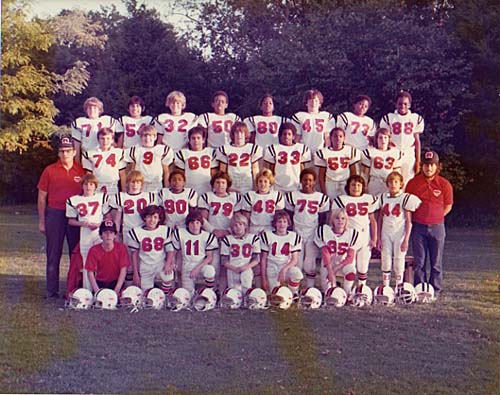
The Oak Cliff Mustangs

Craig-Mustangs-1975

Craig Dunning, Oak Cliff Mustangs, 1975

I had a two-season venture into youth football in 1975 and 1976. I wasn’t so much into football – I was always a baseball guy – but so many of my baseball teammates talked about playing football that I thought I would give it a try.

Most of the talk among my friends was about the Oak Cliff Mustangs, so that was the team I tried out for.

The Mustangs were considered to be one of the best youth football clubs in Dallas in those days (the Jets organization was the other, as I remember it). Therefore, many of the better youth football players chose the Mustangs because of their winning reputation. The odds were stacked against me because the challenge of competing for a roster spot with some of the best football players in Dallas was compounded by my small size and lack of experience. The only thing I brought to the table was effort; I desperately wanted to make the team. Not just any team. This. Team.

The tryout period was rough; it was hot, the practices were long, I had no idea what I was doing, and I didn’t particularly like getting crushed by the bigger, more experienced players. We practiced daily (M-F) from 6-8pm at the north end of Redbird Park, which is now known as Thurgood Marshall Park.

The head coach’s name was Ray Dean. He was old, stern, and ran a tight ship. We had other coaches, but I only remember him and his son (1976), whose name was Kit or Kip.

Craig Dunning, Oak Cliff Mustangs, 1976

Craig Dunning, Oak Cliff Mustangs, 1976

Tryouts were about 2 weeks long. Maybe longer, and definitely shorter for some! I think I have blocked the specifics of tryouts from my memory to preserve my sanity and dignity. The warm up routine was 3 laps around the field (about 1/2 mile) followed by calesthenics. For calesthinics, a couple players, chosen by Coach Dean, led us through a standard set of jumping jacks, sit ups, neck rolls, etc.

After we were sufficiently warmed and stretched, we went through a variety of skills and coordination drills, which were followed by full-contact and blocking pad drills. I did fine in the skills and coordination sessions, but routinely got smothered in the blocking and contact events.

The best part of practice – besides the end! – was scrimmaging. Even though it was stressful because I didn’t know what I was doing at any position they placed me, I most enjoyed scrimmage. To end practice, we did sprints or laps or both. I. Hated. That. Part.

The final thing each night of tryouts was the cut. I dreaded the thought of being called to the “gallows,” but pretty much expected it. Each night, my dad sat in a lawn chair with the other parents watching practice and waiting for the evening to end with the inevitable summons to meet with Coach Dean. After each practice, Dad always inquired: “He didn’t tell you to stay after?” Surprisingly, that didn’t happen the first week. It should have, but it didn’t. And more surprisingly, it didn’t happen the second week, either. I actually made the team! But not because of any skills or potential. I didn’t have either. According to Coach Dean, I had earned his respect and a spot on the roster because he tried but couldn’t make me quit. (Story continues below.)

1976 Oak Cliff Mustangs

1976 Oak Cliff Mustangs

At the year-end banquet, Coach Dean awarded me the Heart Award, which was 10 silver dollars and a handshake. More important to me, though, is what he said when announcing the award:

The recipient of the Heart Award shouldn’t be here tonight. He should not have made the team; by all accounts, he wasn’t supposed to. At tryouts, he was the smallest, slowest, and least qualified player in the bunch. But, he wouldn’t quit. He came in last on sprints. But, he wouldn’t quit. He shuffled along at the back of the pack on laps. And when I made him run more laps for being last, he ran them … slowly, but he refused to quit. He was easily knocked down. But he always got back up. I wanted him to quit, but he wouldn’t. I tried every way I could to get him to quit. But, he wouldn’t. And because he wouldn’t quit, I kept him on the team.

Ladies and Gentlemen, the recipient of the the Heart Award is Craig Dunning.

For two seasons, I didn’t quit. For two seasons, I went to practice every day Monday thru Friday, then to games on Saturdays. I rarely got to play in the games. It didn’t matter if I sat on the bench near the coach or stayed out of his way, I wasn’t getting into the game until mop-up time, if at all. Sometimes that meant less than 01:00 remaining on the clock. Many times I never entered the game at all. Only a few times in two seasons, did I get into a game when the outcome wasn’t yet decided. On one of those occasions, an away game against the Grand Prairie Packers, I made the most of my opportunity: I sacked the quarterback twice on consecutive plays. (Story continues below.)

In this undated photo, Craig Dunning pursues an opponent. This may be the only existing photo of Dunning in action on a football field.

In this undated photo, Craig Dunning (20) pursues an opponent. This may be the only existing photo of Dunning in action on a football field.

I know it was hard on my parents to see me work so hard and get seemingly so little out of it. There was a financial cost for them, to be sure. But, there must have been an emotional cost, as well. Yet, they never complained in my presence of either. They were team players. I appreciate their willingness to let me fight and struggle and hurt in this way, so that I could be part of something bigger than myself.  I had made the roster of one of the best youth football teams in Dallas, Texas. I was an Oak Cliff Mustang! That was important to me. Thus, it was important to them and they willingly paid their own price for that to happen.

I learned much about life in those two years. I learned the value of getting up when I got knocked down. I learned the value of putting one foot in front of the other and continuing to move forward, even slowly if that’s all I have left in me. I learned the value of being part of something bigger than myself. I learned about team dynamics and team work. I learned the value of suffering. I learned the taste of victory and defeat. I learned what it feels like to be unappreciated. I learned what it feels like to sit the bench. I learned how to earn respect.

Thank you, mom and dad. Thank you, Ray Dean. Thank you, Oak Cliff Mustangs 1975 and 1976.

My First Motorcycle

FT1-Mini-Enduro_1971_01On my seventh or eighth birthday, my Grandad took me out to his car to get my birthday present. I never could have imagined that when he opened the trunk of his car I would see a motorcycle. But that’s exactly what happened!

There, somehow wedged in the trunk, was a gently used desert orange Yamaha Mini-Enduro motorcycle that looked like the one in the photo on the right.

With a little effort, my grandad was able to wrestle the bike out of the trunk and on to the ground. I don’t remember anything that happened between the moment the tires hit the ground and the moment I mounted the bike in the field behind our mobile home. But, I have a very vivid memory of my mom and grandmother watching me through the back window. Their looks of disapproval quickly morphed into a grimace as I approached the fence with no idea how to stop. As they looked away, I crashed into the fence. Fortunately, I wasn’t hurt. Neither was the motorcycle. Had I been hurt, I suspect, that would have been the end of that adventure.

Things got better pretty quickly as I learned how to throttle down and use the breaks, which was good because my mom was not happy about the surprise birthday gift.

It wasn’t long until I was racing around the field with a couple older kids, Jeff Baden and David Owen. They were riding Honda Trail 70s, but I was able to keep up in spite of their age and 10cc advantage. The field, about 5 acres, had a trail worn around the perimeter and a small pitcher’s mound type bump on the south end over which we jumped on each go-round. Round and round we went, never tiring of the blaring buzz of the 2-stroke engines, nor the repetition of our course.

I only had one mishap, and that ended up not being anything serious. On my way home, I entered the road while looking over my shoulder and didn’t realize I had crossed the road and was nearing the opposite side curb. When I looked forward, it was too late; I hit the curb and fell over. There was no damage, but the engine was flooded and I couldn’t get it started. Not wanting my parents to know that I had wrecked, I began to push the bike home, hoping I could get it started in a few minutes. I’m not sure how long I had been pushing the bike, but it was long enough that my parents noticed the quiet from the field and got in the car to come look for me. We met on the road, but I only told them that I couldn’t get it started. I never told them why. They never asked for more information, so I didn’t offer any.

The motorcycle fun lasted only a couple years because the owner of the field didn’t want us riding on the property. He had plans to develop it; at least that is what the signs said. However, nothing was done with the property for 30 years. In 2004, Arcadia Park Elementary School was relocated to a new facility on this property.

Had I not had to sell the bike for lack of a place to ride, I think I would have started racing motocross or possibly doing hill climb events because my dad really enjoyed both. Actually, we all seemed to enjoy watching them. But, I guess such wasn’t meant to be. And, I didn’t have another motorcycle until I was in high school.


The Wedding Dress

Before we were married, Colleen was living in Czech Republic and I was living in Israel. Since we planned to live in Israel after our wedding, we decided that Colleen would bring her stuff to Israel and then, we would fly to Texas for our wedding. Our flight out of Israel was exactly 12 hours after Colleen arrived from Czech Republic, which isn’t quite enough time to see the sights.

When we arrived in Texas, very few details for our wedding remained to be arranged since most were either taken care of abroad, or, alternatively, by friends in Texas. Among the details that were managed from abroad was Colleen’s wedding dress, which she had custom made in Czech Republic. It was beautiful, inexpensive and hand carried. We didn’t take the chance of having it damaged or lost in checked baggage; and it came in handy as we went through airport security at Ben Gurion Airport in Tel Aviv.

Usually, Israel is a destination point, not a transit country. That being the case, I suspected that her flying from Czech Republic to the United States via Switzerland and Israel might raise some serious concerns for the security team at Ben Gurion. Particularly, if she was in Israel only 12 hours. That’s just not a normal route.

When our turn came to go through security at Ben Gurion, we approached the counter expecting to be given the “full treatment.” It seemed reasonable given our particulars: we’re not Jewish, we’re not Israeli, and Colleen had only been in the country 12 hours. The agent who handled us was thorough, but courteous, which was appreciated. As he quickly moved from question to question, he finally arrived at the standard, “where are you going and why” questions.

“Well, we’re going to Texas to get married,” I answered. He smiled as if he had finally found a chink in our armor and asked,”Can you prove that you’re going to Texas to get married.” As quickly as I noticed the look in his eye, the answer came to me: “I can’t prove that we’re going to get married, but we do have a pretty good clue. She has her wedding dress!” I responded. “Can I see it,” he countered as we seemed to be sparring now. So, with great fanfare, I “jabbed” him with a little faux drama: “Sure! But in our tradition, I can’t see her dress before the wedding, so give me a chance to turn around!” Colleen pushed the garment bag toward our interrogator as I spun away. The timing was so perfect it had to be choreographed. But it wasn’t.

Apparently weakened by my ability to verbally spar, or more likely realizing that we were telling the truth, he delicately opened the bag just enough to peak inside. Upon recognizing that it was, in fact, a wedding dress, he blushed and quickly zipped the bag closed and said, “Okay, you can go.” And, as quickly as he zipped the bag closed he covered our bags with security stickers and moved us on to the ticket counter.

That was it: One of our easiest journeys through airport security. The interview lasted only a few minutes and the issue of Colleen’s 12 hour transit in Israel never came up. I felt victorious. Colleen was just happy that I didn’t get us dragged into the back room for the extra special attention offered to shady characters.

Next stop: Newark.