Friday Fotos – Do You Remember When…

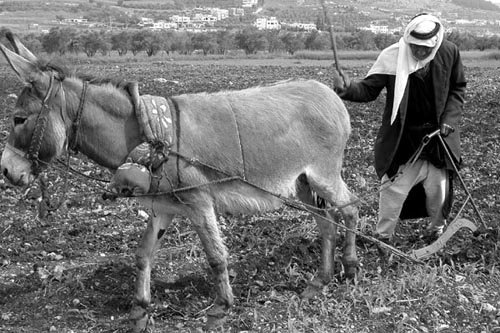
This farmer is from a generation of farmers who plow the “old fashioned” way: behind a mule. Don’t be fooled, this foto didn’t come from an old book. I took it earlier this week.

We met this farmer whose name is Na’am, in a small field outside of Shechem. Mr. Na’am was very friendly when we stopped and asked if we could take his foto. He was happy to speak with us, though I couldn’t understand much of what he said. My Arabic skills are fairly thin and he couldn’t speak English.

Unintentionally, I demonstrated the cultural divide when I asked the name of his mule. He did a double take and looked at me as though I had just parachuted in from Mars before answering, “Mule.” I guess Arab farmers don’t name their animals.

Friday Fotos – You Weren’t There

I came, but you weren't there. MessiahIn an effort to jump on the bandwagon of posting a photo on Friday, I’ll offer this picture of a bumpersticker that I saw on a truck in the Negev desert. It is also a bit of a followup to my last entry about the Chabad group.

The sticker says: I came and you (plural) weren’t there. The Messiah…

The design is a spinoff of Chabad’s “Prepare for the Messiah” campaign from the early-mid 1990’s. The gold background with words above and below the rising sun was the graphic layout of their banners, posters, flags and stickers.

As one who believes Jesus to be the Messiah, this particular sticker communicated to me a bit of razzing the Chabad. In other words, “Jesus already came and you didn’t receive Him.” However, I’m not certain that was the intended message.

Everybody’s Talking About the Resurrection

Since Sunday, April 16, was Easter Sunday, you might not think my title is strange. Perhaps where you are, everybody is talking about the resurrection. However, here in Israel, even on Easter Sunday, everybody isn’t usually talking about the resurrection, unless, of course, you were one of 10,000 people packed into Tel Aviv’s Nokia Arena on Sunday night.

One of the organizers, Yoni Kahana, happily described the evening as “an amazing turnout.” He went on to say that that “Everyone came away with renewed faith in the imminent coming of [the messiah]. He may not have come on Sunday night. But he will truly be revealed any second.” Wow, ten thousand people gathered together in Tel Aviv, Israel excitedly anticipating the return of the messiah. Now that is something that will even get a Baptist to shout “amen,” maybe even clap.

The interesting twist on this, however, is that on this Easter Sunday they weren’t talking about Jesus’ resurrection and imminent return, they were talking about the (hoped for) resurrection of the late Rabbi “Messiah” Menahem Mendel Schneerson, who died in Brooklyn in June 1994.

MessiahThis kind of resurrection talk isn’t new; it’s just different in that it is open and public. In the years since Schneerson’s death, particularly in the days immediately following, many of his followers proclaimed their belief in his identity as Messiah, but it was almost an “in house” discussion. A discussion that, at times, grew to more than a friendly discussion, which threatened to completely split the Chabad movement.
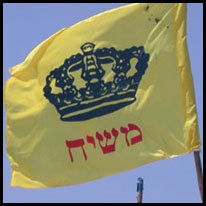
In recent years, though, I have noticed a growing number of posters along the highways proclaiming The Rebbe, as his followers know him, as Messiah. Some are more subtle than others, like the one on the right, for example: On this flag, the word Messiah (in Hebrew) is written under the royal crown. If you don’t have more background information on this campaign, it would be easy to dismiss this as a fervent, religious Jew simply flying his colors.

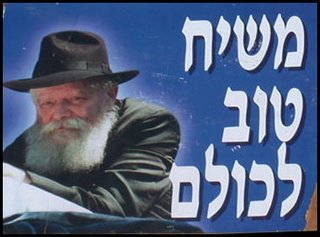
This poster (left), commonly seen all over Israel, King Messiahfits into the less subtle category as it says “King Messiah” under the photo of The Rebbe. I’m not certain that this particular poster was at the convention hall on Sunday night, but the sentiment certainly was. Rabbi Zalman Notik of the Torat Emet Yeshiva in Jerusalem spoke openly of Rabbi Schneerson as the messiah. Furthermore, he supported the missionary zeal for which Chabad has become known when he said, “…the most important mitzvah [commandment] is to publicize the idea that the Rebbe is messiah.” No wonder Chabad is often characterized as the Jewish evangelicals: They believe that Rabbi Schneerson is the messiah and that he is good for everyone, particularly Jews.

A religiously observant, Jewish friend once told me that he didn’t agree with Chabad’s or my desire to tell others about our faith. “I believe” he said “that what I believe is good for me, but not necessarily for everyone else.” I pointed out that that is one major difference between us: I believe that Messiah is not only good for everyone, but necessary. Apparently followers of the Chabad sect of Judaism believe more like I do about messiah in that regard. Our disagreement comes in the identity and function of the messiah, not the desire for others to know about him.

The Messiah is good for everybody.This poster (right) includes with The Rebbe’s photo the words, “Messiah is good for everybody.”
Rabbi Schneerson Quick Facts:
Date of Birth: April18, 1902
Place of Birth: Nikolaiev, Ukraine
Visits to Israel: None
Date of Death: June 12, 1994
Place of Death: New York, USA

Election Souvenir 2006


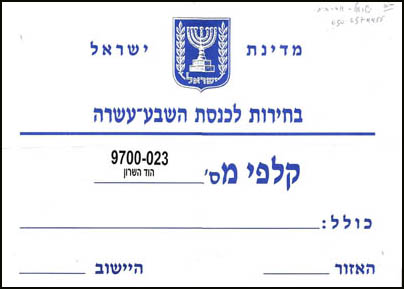
The sign above (scanned and reduced) is my souvenir from yesterday’s Israeli Parliamentary Elections. I didn’t vote because I don’t have that right, but I did end up with the polling place sign. It had been thrown over the fence into our yard from the school behind our house. I’m not sure if it was thrown in exuberance or exasperation at the results. Perhaps it was simply easier to throw it over our fence than put it in the trash can. In any case, I have a neat souvenir from the 17th Knesset election.

Some have asked what I think of the results. I’m no political expert, but it seems clear that the turnout was disappointingly low, particularly for the Likud (Bibi Netanyahu’s party, Sharon’s former party). Ariel Sharon’s new party, Kadima, came out the winner, but not the big winner. In fact, their 28 seats are less than 1/3 of the seats in Parliament.

This is the second weakest winner in history. The lowest number of seats by a winner is 26, won by the Labor Party (Ehud Barak) in 1999. A note of warning: That government lasted only 18 months.

When I use the word winner it means that a particular party, the Kadima party in this case, has the responsibility of bringing together a coalition of parties to form the government. (Ideally, the winning party would win 61 seats themselves, but that is really unlikely these days, and clearly didn’t happen this time.) The less seats a winner has, the more unstable the government seems to be because in order to get the necessary 61 seats, they typically have to bring other parties to the table that have different (sometimes opposing) agendas, which work contrary to each other. And this is when politics really becomes politics.

I’m not making any predictions of brevity or longevity, other than to reference the apparent weakness of winning parties with so few seats.

No Chance for Peace?

While visiting the Old City of Jerusalem today, we stopped to visit a young, Arab shopkeeper (probably not the one you’re thinking of). During our visit, I asked him a number of specific questions regarding his current job, potential careers for young Arab men like him, and his overall impression of the “situation” in the region, specifically Israel and the West Bank.

It was interesting to hear his answers to my questions and to see him become more transparent, offering heartfelt answers to very probing questions about war and peace once he realized that there was no trap or debate at the end of my enquiry. He realized that I was simply interested to hear what he thought about something that millions of people think about around the world – the Arab-Israeli conflict. For once, he had a genuinely interested audience.

He started with a very typical line of argument among Arab shopkeepers in Jerusalem: If the Israelis would stop doing “X, Y, and Z” and start doing “A, B, and C” there can be peace. When I began to probe below the surface of this argument, asking for definitions and specifics about “X, Y, and Z,” as though he were in a confessional he suddenly said, “There can’t be peace!” In an effort to make sure that I had heard him correctly, I asked him to repeat himself. “There can’t be peace. Oh maybe, one or two years, but real peace is not possible. The Arabs hate the Jews, and the Jews hate the Arabs and the two simply can’t mix – not even side by side.”

While only one young man verbalized this today, I think it represents the core thought and feeling of many (perhaps most) on both sides of the divide. And, if that is true, whether or not Iran is disarmed, or the mess in Iraq is finally cleaned up, doesn’t really have a great bearing on peace in the Middle East, though many politicians keep talking as if the resolution of either or both of those situations will bring forth “peace in our lifetime.” Do they really believe it, or are they just trying to get elected?

I wonder how such a conversation, if broadcast widely on television and radio, might influence the Israeli elections next week. Would it make the more left parties try even harder to prove that they can cut a deal with the Arabs? Would it make the right parties try even harder to prove that the Arabs can’t be trusted? Would it matter at all?