Israeli Elections 2006

Simply put, Israeli politics are not boring. It’s probably true that “politics is politics, no matter where you are,” but the political structure in Israel does offer some distinct differences from the American system.

One of the things you will probably not see in American politics is the political rival illustrated as a mokey as in this advertisement:


The caption says, “Enough of ignoring corruption.” By the way, the three “monkeys” are the leaders of the three largest political parties (r to l: Benjamin Netanyahu, Ehud Olmert, and Amir Perez). I can’t see either Republicans or Democrats not demanding an apology and the withdrawal of an advertisement like this.

One thing you may see in American politics is the message of this advertisement:


“I believe in God, but I will seperate between religion and government.” Unfortunately, too many politicians say they have religious beliefs that they can dismiss in order to fulfill their political responsibilities.

Finally, an advertisement that is on the agenda in America:
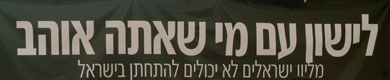

“Sleep with whomever you want…” This is a platform for civil weddings (currently not available in Israel) that include homosexual marriages.

Dragging Me Into the Future

I’m unhappy with my Israeli bank today. I knew it was inevitable, but I’m still not happy.

I went into the bank today to make a deposit (some cash and a check) and as I approached the teller, a woman I didn’t recognize, dressed in a bank-issued logo shirt stepped in front of me and asked what I wanted. I thought it was only too obvious since I was in the teller line, so I was caught a bit off guard.

When I told her I wanted to make a deposit, she told me I couldn’t make a deposit with the teller, only through the ATM. In an effort to clarify the new procedures, I asked, “I’m not allowed to make a deposit with a teller?” She was puzzled by my question and answered, “It’s not that you aren’t allowed to make a deposit with the teller, you just can’t do it anymore.” She offered to guide me through the new procedures at the ATM.

Now, I have to deposit checks at the machine inside, and cash at the machine outside. This is all for my benefit and convenience the manager assured me when I went to offer my complaint about the new way of doing things. I didn’t expect her to reverse the decision to “advance technologically,” but I felt it important to let her know exactly why I was disappointed.

Many of you know that I have a lot of technology gadgets and do a lot on the Internet, including banking. So, you might be wondering what is the big deal for me to move into the age of technology and make deposits via the ATM rather than through a teller. First the ironic point: The manager said the changes were to improve convenience. So, lets see how well the changes meet that goal: Instead of one transaction at the teller like before, I had to make two – one inside and one outside. The machine inside is only accessible during banking hours and the one outside has no way to supply envelopes for the deposit, which means it only “works” during banking hours unless I make a special visit to stock up on envelopes. Additionally, each transaction at this bank has a service fee. Now, I have two compared to only one prior to the changes. Additionally, self-service deposits prior to the changes were without charge, but not anymore. What happens if there is a discrepancy when I deposit cash in the outside ATM? There is no way for me to witness them counting my money, so any discrepancy becomes my word against theirs. My evaluation: The changes don’t meet the goal of customer convenience.

The second point is what I came to realize only today and is by far more important than the first. The truth is, I go to the bank so seldom that convenience isn’t a real issue for me. Then what’s the big deal? Human contact is my answer. As a foreigner here, I realized today that it has been an important thing for me to know that people know me when I go into the bank, even if only once a month or less. Without me needing to remind them, the tellers know that my account is on a passport number and not a national identity number. This information is important because bank accounts are located according to identification numbers, even though each account has a specific number of its own.

If I hadn’t had human contact in the bank, I wouldn’t have been able to get approved for an Israeli credit card, which has been more important for us as a symbol of stability here than for purchases. Our account numbers here, particularly as foreigners, don’t justify a card, but contact with people gave us enough credibility to be approved. When we had to put down a large security deposit for our current house, we had been directed to put it in an account that would have been to our disadvantage. A clerk, who recognized me, gave me some good direction on a type of secured account that would be better for us financially, and meet our security deposit needs. I will not have these things – the service or personal contact – anymore because our bank is moving into the future, also known as technology and automation.

I know I probably sound like an old-timer or a person full of self-contradictions, but I’m not happy about this “progress.”

Persecution in Israel

Jesus said, “Blessed are ye, when men shall revile you, and persecute you, and shall say all manner of evil against you falsely, for my sake (Matthew 5:11 KJV).”

The latest group who were blessed in this manner in Israel was the Beersheva Congregation. You can see some photos and videos of this orchestrated protest turned assault here. [Update: The link is no longer good.]

The Beersheva and Arad congregations have been particularly targeted over the last couple of years and seem to be growing more vulnerable to such attacks. The police have been fairly ineffective at protecting the congregants in these cases. Thankfully, no one was seriously injured, but it probably will not be long before that changes. Mob violence can get out of hand very quickly, even unexpectedly.

Persecution in Israel is primarily accomplished through social pressure intimidation, and ostracism, but occasionally manifests itself in violence. There is a tremendous amount of social stigma placed upon Jews who believe in Jesus.

Currently, it is legal for Jews to believe in Jesus and promote that belief through many different means, except toward those under 18 years of age. However, over the last eight years there have been a few attempts in Parliament to make it illegal to evangelize at all, or in another case to possess literature that might be used to encourage one to convert. So far, all political attempts to silence Jews who believe in Jesus have failed.

Please pray that the believers in Israel would “Remember the word that I [Jesus] said unto you, The servant is not greater than his lord. If they have persecuted me, they will also persecute you; if they have kept my saying, they will keep yours also. 21But all these things will they do unto you for my name’s sake, because they know not him that sent me (John 15:20-21 KJV).”

New Driving Laws

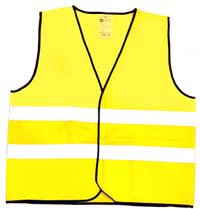
As of January 01, 2006 every vehicle on the road in Israel must have at least one reflective safety vest as shown in the picture at the right. This is the Israeli government’s latest effort to make driving a safer experience. The vest must be worn any time a passenger is outside a vehicle that has stopped on an inter-city road.

I’m sure some will try to get by without buying a vest, thinking they will probably never stop on the highway – no flats, wrecks or breakdowns allowed. However, it seems the government is one step ahead of that type of thinking: In addition to a functional spare tire, jack and reflective triangle, the new reflector vest is required to pass the yearly auto safety inspection. So, there seems to be no way around it.

Whether it will make a difference in road safety remains to be seen. But it is one part of the government’s growing effort to make the roads safer. And I’m thankful for their effort.

Got Milk?

The old adage, “there’s no need to cry over spilled milk,” is probably fairly accurate. However, my experience today, was begging me to cry over spilled milk.

This afternoon, as we were ending an eventful grocery shopping experience (we have a rowdy 2 year old) at the cashier, I noticed the line wasn’t moving: The cashier had for some unannounced reason wandered down to the customer service desk. Finally, she returned and as she was putting the finishing touches on the current customer’s transaction, the customer in front of me allowed a friend with a handful of groceries to cut in line from the opposite direction. Now that I replay that event in my mind, I realize they had conspired the whole thing while waiting for the wayward cashier to return.

In an effort to divert everyone’s attention from his obvious selfishness, as the cashier was waiting for the register to finish its tally of his goods, he turned away from her and started waxing eloquent about nothing with his accomplice, the guy in line ahead of me.

Almost immediately, the register indicated the amount due, which the cashier dutifully repeated in his direction. He wasn’t listening: By chatting up his accomplice, he was avoiding the white elephant in the line – his own presumptuous self-importance. The cashier waited. I waited. Mr. Rude ignored her and avoided making eye contact with me. He knew I was staring at him. She waited. He continued talking. She continued waiting. Eventually, enough was enough. Actually, enough was more than enough and I gently (really) asked if he wouldn’t mind paying, and then I offered a reminder that he had already cut in line. Realizing the charade had been unsuccessful, he said, “you’re right,” paid the cashier and disappeared.

Now that Mr. More-Important-Than-Everyone-Else had finally moved along, so should the line, I thought. And the line was starting to move forward until IT happened. From deep within the mountain of groceries that were resting on the conveyor belt came a trickle…of chocolate milk. A jug of milk had sprung a leak, apparently from being crushed under too much weight.

From the reaction of the cashier, an uninitiated person might have thought toxins were seeping out of Grocery Mountain and expected her to call the haz-mat team. She hopped up from her stool [1], covered the electronic eye that automatically advances the belt with her left hand and reached for her roll of toilet paper [2] with her right hand. All this was done in one motion with the grace of an Olympic gymnast. Nice performance, definitely deserving of high marks.

When the customer realized what was happening, he tried to help by removing any items that had been touched by the offending milk. “Stop! Stop!” she exclaimed, “You’re making it worse for me.” Clearly, she didn’t want the milk to flow further down the belt and into the motor, but she was more concerned that the milk NOT leave residue that might contaminate groceries belonging to future customers. So, she dutifully cleaned each item, making sure there was no milk left behind. One by one, she wiped them all.

In Israel, milk poses a different problem than say soft drinks or juices. Yes, soft drinks and juices will ruin an electric motor the same way chocolate milk will, but they don’t create kosher problems like milk can.

In Jewish dietary laws, it is forbidden to mix meat and milk products. This principle is loosely based on the biblical prohibition against “boiling a kid in its mother’s milk,” which is found 3 times in the Jewish Bible – commonly referred to as the Old Testament (Exodus 23:19, 34:26, and Deuteronomy 14:21). I say loosely, because the Bible clearly does not forbid mixing milk and meat. However, the rabbinical authorities have determined the safest course is to forbid all mixing of milk and meat. The result is a distinction between meat restaurants and dairy restaurants; meat dishes and utensils and dairy dishes and utensils in religious homes; and panic in the supermarket if milk spills.

The potential problem of mixing meat and milk in this way was only theoretical since all the meats in the store are sealed in plastic. However, if some loose milk were to be carried into someone’s kosher kitchen and contact some meat, a theoretical problem would become a very real problem. This cashier was not taking any chances with theoretical or real problems. We would just have to wait for her to fix the situation; and wait we did.

Got milk? If so, don’t spill it.

[1] In Israel, grocery store cashiers sit while they work.
[2] For some reason, all store clerks in Israel use toilet paper to clean the counters and glass. Why they don’t use more sturdy paper towels is a mystery.