Merry Christmas

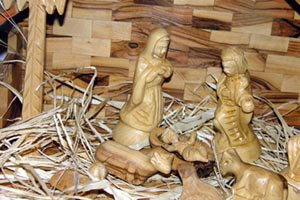
This is our manger scene, which was carved in Bethlehem. It may not resemble the reality of what Joseph and Mary experienced, but it is a precious reminder to us of the meaning of Christmas: God’s Son humbly became God in the flesh.

We hope that you have a very Merry Christmas!

Watching Their Flocks By Night

December 25 has long been the recognized date for western Christians to celebrate the birth of Jesus Christ. Please take note of the wording of the previous sentence: “…recognized date…to celebrate…” I didn’t suggest that it is the actual date of his incarnation, though I’m not opposed to the possible accuracy of such a date. The distinction is important because there seems to be annual discussions surrounding the inaccuracy of the December date, and these discussions typically include two points of proof: The alleged pagan origins of Christmas and the details about the shepherds in Luke’s birth narrative.

So common is the assertion that Christians simply co-opted the date of the pagan celebration of the winter solstice, even among many pastors, that it is almost unthinkable to consider another possibility. As evidence of the pagan origins of the holiday, the date and the use of trees in the traditional celebration of Christmas are generally the main offerings.

The use and decoration of trees in the celebration of Christmas, may, in fact, be evidence of an effort of Christians to redeem some elements of a pagan holiday. However, William J. Tighe suggests that we are only getting part of the story by focusing on the presence of the tree. His research indicates that rather than Christians co-opting a pagan holiday, it was pagans who appropriated a date thought significant by early Christians. He stops short of claiming there was a formal Christian celebration of Christmas on December 25, but he does suggest that it was recognized as a possible date of the birth of Jesus prior to Roman Emperor Aurelian instituting the pagan festival “Birth of the Unconquered Son” on December 25, 274. (You can see Tighe’s article here.)

Clearly, this isn’t incontrovertible evidence that Jesus was born on December 25, but it should cause one to pause before accepting as fact that celebrating Christmas on December 25 is simply following a pagan custom. The second issue is more interesting to me for the symbolism that it offers.

According to the Gospel of Luke (2:8), on the night of Jesus Christ’s birth, in the region of Bethlehem, there were shepherds out in the fields watching over their flocks. In the annual discussions about the actual date of Jesus’ birthday, Luke’s account is frequently offered as proof that clearly eliminates the possibility of a December 25th date for the birth of Jesus. Those who use Luke in this manner typically point to two facts: Location and time. The shepherds were in the fields at night.

It is interesting to me that people offer this as “proof” that Jesus couldn’t have been born in December, as though the weather patterns in and around Bethlehem are as definite as, for example, those in the Arctic Circle. The fact is that the weather in this area is not so definite. No doubt, sometimes December nights might be too cold and wet for shepherds to be in the fields. This year, interestingly enough, might be one of those since snow is in the weather forecast. However, while December is clearly within the period correctly designated as the “rainy, winter season,” it isn’t a foregone conclusion that the weather conditions around Bethlehem will be either rainy or cold. On this ground alone, this is a weak argument against the possibility of a December 25th birth of Jesus.

More interesting to me, though, is what I discovered some years ago as I considered this topic. According to Alfred Edersheim [1], his reading of the Mishnah [2] led him to conclude that the sheep kept around Bethlehem were, in fact, kept in the fields through the winter because they were sheep designated for slaughter at the Temple during Passover.

Consider the symbolic significance of Edersheim’s suggestion: The shepherds standing watch over sheep destined for the Passover sacrifice were suddenly visited by the angel of the Lord who was announcing the birth of the Savior, who John later identified as the lamb of God. Yes, Jesus, the Lamb of God, destined to be sacrificed for the sins of the world at Passover, was born in Bethlehem, where the Passover lambs were traditionally raised.

So, next time someone tells you, “We know that December 25 isn’t the actual date that Jesus was born” you might offer that the evidence may not be so clear. In any case, wish them a merry Christmas and make sure they clearly understand the significance of the fact that God became flesh – that the Lamb of God was born in Bethlehem.

Merry Christmas!

[1] Edersheim, Alfred. The Life and Times of Jesus the Messiah. Hendrickson Publishers, Peabody, MA. n.d. Book I, pp. 186-187.
[2] The Mishnah is the Jewish oral law, and is now collected in written form.

Since writing this post, I have found some others who have integrated Tighe’s assertions in a good way. See the New Covenant blogspot here.

Screwtape Letters Part 1

screwtape-logo.0Since the movie version of The Chronicles of Narnia: The Lion, The Witch and the Wardrobe has hit the American theatres and C.S. Lewis has become a common topic of conversation, I thought it would be fitting for me to refresh myself with one of my favorite books: The Screwtape Letters. (To find your own copy, click here.)

In this book, Lewis provides the reader with correspondence between Uncle Screwtape, a management-level demon, and his entry-level demon nephew, Wormwood, whose purpose is to tempt humans to avoid encounters with the Enemy. In the context of this book, God is identified as the Enemy, which is uncomfortable for me to read, but understandable in this context since God is Satan’s ultimate enemy.

In this fictional tale, C. S. Lewis offers an “insider’s view” of the presumed thought process and training program in the bureaucracy of the demon world. While it is admittedly fictional, on several occasions Uncle Screwtape’s instruction and/or encouragement to his young nephew left me thinking “that is a very reasonable possibility.” And, whether or not the demon world operates precisely as portrayed, the imagery is helpful in assisting the reader to think more biblically regarding the battle between the Spirit and the flesh, and to recognize that demonic temptations toward unbelief aren’t coincidental occurrences. Rather, they are well-orchestrated events that start in apparently benign ways: a glance here, disbelief there or a misplaced trust elsewhere.

I offer the following quotes for your consideration. Perhaps they will be as thought provoking for you as they were for me.

PREFACE

“There are two equal and opposite errors into which our race can fall about the devils. One is to disbelieve in their existence. The other is to believe, and to feel an excessive and unhealthy interest in them.”

Clearly it is both naïve and spiritually dangerous to disbelieve in the existence of devils [demons]. The Bible is clear in this matter: See for example, Luke chapter 8:26-39.

To become obsessed with the demon world is also dangerous, and can take away attention more appropriately directed toward Jesus. The apostle Paul encourages Christians to dwell on whatever is true, whatever is honorable, whatever is right, whatever is pure, whatever is lovely, whatever is of good repute, things of excellence or worthy of praise (Philippians 4:8).

“Readers are advised to remember that the devil is a liar.”

See John 8:44.

To be continued…

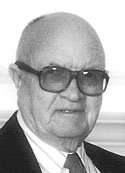
Farewell, My Friend

Wally ReedOne of the difficult things about living over seas is how things change back home. It’s not surprising or unexpected because we too are changing, it’s just that some of the changes are harder to deal with than others.

Today, we received our home church’s weekly bulletin from December 11, 2005 and saw the following:

Dr. and Mrs. Griffin Jones and our Church family extend their deepest sympathy to Mrs. Melba Reed, and Mr. Guy Reed in the loss of husband and father, Wally Reed.

In other words, things at home had changed in a way that was sad for me: Wally Reed died on Saturday, December 3, 2005.

However, to say that Wally died can easily give the wrong impression. Wally didn’t die in the sense that he ceased to exist. Rather, Wally was transformed from a well worn, even broken body into the glorious presence of his Lord, Jesus Christ.

Though we had previously met in Israel, my first real opportunity to get to know Wally was on a mission trip to Mexico in 1994. Our church, Temple Baptist, in partnership with a Mexican Bible college, was sponsoring the construction of a church building in a small sugar cane farming village. For a few reasons I counted it my privilege to end up bunking next to Wally and his son Jon. Not only did Wally have a footlocker overflowing with snack goodies, which he freely gave away, but he was a genuinely nice man who was very enjoyable to be around.

Wally laughed easily and had an ability to infect others with the humor of a situation, even if he was the victim of the funny mishap. For example, one of my favorite stories was of Wally getting lost in the Vatican. On their church tour to Israel, the group had a stopover in Rome and during the tour of the Vatican Wally mistakenly got in line behind the wrong group and followed them to the upper levels of the Vatican. Though he admitted to being a bit frightened when he realized his mistake, while re-telling the story he could still laugh about the predicament he had gotten himself in: He couldn’t speak Italian, he didn’t know anyone he found himself surrounded by and, more importantly, the long, narrow, steep staircase he had climbed was starting to take it’s toll on his ability to breathe. As he sat down to rest, he said that he started to think, “I’m going to die at the top of the Vatican, and no one is going to know who I am or what to do with me.”

After his colon surgery, Wally laughingly told me, “Well, I came in here with a colon, now I’m going home with a semi-colon.” He was taking his situation in stride and making a witty, play on words, which revealed not only his sense of humor, but his love of word games as well. Every time I visited Wally, he made sure to show me the puzzle he was currently working on and to tell me the books he had recently read.

The last time I dropped in on Wally and Melba, he was sitting in his recliner, creatively remodeled to accommodate his long frame, wearing an oxygen tube working a crossword puzzle. His mobility had been restricted, though He and Melba were still getting out as much as possible, carrying a portable oxygen tank, but he didn’t complain about the restrictions. He simply took it in stride, apparently realizing that it was simply the result of a lifetime of hard work in a hard industry, and that given all the things he had experienced in life, this was a much better situation than it could have been.

Wally was modest, intelligent, and easy for me to be around; I’m richer for having known him. Thanks for the memories, Wally; I’ll miss you, my friend.

Wally’s obituary can be viewed at the bottom of this page.