Choosing Thomas

The Dallas Morning News has published a beautiful article Choosing Thomas, which details the heartbreaking and joy giving story of TK and Deidra Laux whose son Thomas was a victim of Trisomy 13.

As a parent who has walked this path, I want to complement the staff of The Dallas Morning News on a wonderful job of presenting this story, capturing the heartache and disappointment and fear that parents feel when faced with the terrible news: “There appear to be some serious problems.” The staff also did a wonderful job in capturing the surprising joy that a baby with “serious and fatal problems” brings to his/her parents and family and friends.

As I watched the video and read the accompanying article(s) and journal, I continually thought: This is our story. That’s what happened to us.

However, our story was different in that our Abigail Hope didn’t survive to birth; she was stillborn. Our story was also complicated by the fact that it took place in Israel, far away from our family and most of our life friends.

We were thankful that there were a few people here who hurt with us, but so many seemed to dismiss our situation as nothing too serious. Perhaps some just didn’t know what to say, which is common. But in many cases, it was simply a cultural callousness toward these types of things. At least one person assumed Abigail didn’t have a name yet, thus she didn’t have “person hood.” He was wrong on both counts. Others blindly followed the traditional Jewish thought that a life duration of more than thirty days establishes a human being as a viable person. If a child dies before that time, he is considered to not have lived at all.

The medical community offered no comfort either since they could only think of one thing to say: “TERMINATE NOW!” In fact, the country’s expert in 3-D ultrasound and genetic abnormalities was shocking in his callousness: In response to our question regarding the reasonable expectation of length of life for Abigail should she survive to full term, he said, “Not long, but I would hope she wouldn’t live one second! Her problems are too severe to want her to live. My advice is to terminate NOW!” Unfortunately, that wasn’t his only disaster in bed side manner, but I’m not interested to recount the others here.

“Terminate now,” was so foreign to our thoughts, the doctors all thought we had parachuted in from another galaxy. We insisted that we wouldn’t even consider killing Abigail, and the doctors looked at us in utter disbelief and disdain. Who were we to be so resistant to their advice? They were the experts; and they know the outcome of these situations. I knew our position was right, but it was nice to hear other parents in our situation agree with us – even three years later: Toward the end of the video report [in a voice over the funeral scenes] Deidre Laux clearly articulated our thoughts: “We didn’t not terminate because we were hanging onto some sort of hope there was a medical mistake or there was going to be some some sort of medical miracle. We didn’t terminate because he’s our son.” Because Abigail was our daughter! We loved her, broken body and all; how could we even consider breaking her body more?

Burial is another point at which our story and the Lauxes’ diverge. In Israel, most cemeteries are religiously segregated, which is to say that Abigail couldn’t be buried in a Jewish or Muslim cemetery, the most abundant cemeteries here. As it turned out, she wasn’t welcome to be buried in the evangelical Christian cemetery either, which is a story in itself.

This all happened so fast, and the hospital staff was pressing us for an answer regarding the disposition of the body. Dealing with death, especially that of our own child, in Israel was all new to us. We didn’t know to whom to turn. And it was late Thursday afternoon, which is to say that the Sabbath was quickly approaching and things would be shutting down for the weekend. We made a few phone calls, only to reach dead ends or endless stalling, which we understood to be a no without actually saying, “no.” Meanwhile, the hospital was pressing for an answer.

Finally, we decided to use the service of the Jewish burial society, who gathers the bodies of all children under the age of 30 days and buries them in an unmarked grave. I guess to their credit, even though they don’t consider the children to have genuine person hood, at least they give them a somewhat proper burial.

I recommend this video report to you. If you aren’t familiar with the emotions and thoughts and struggles that take place when parents are told, “there are some problems,” this report will give you some insight.

If you are struggling with the issue of termination, please watch the video – to the end.

In our days on this road, we leaned heavily on each other, but more heavily upon the Lord: “Hear, O Lord, and be merciful to me! O Lord, be my helper! (Psalm 30:10)” He was, and continues to be.

A Great Truth, A Great Hope

For the Practical Among Us

At CasketFurniture.Com you can get a practical piece of furniture like the Rayonnant Eternaltainment Center pictured here. “It comes apart quickly to create your final place of rest.” Additionally, once the center “casket is removed, the two sides slide together and can be used [by those left behind] for years to come.”

“Why buy a casket for just one day? At CasketFurniture.com, our products can last you a lifetime, and still be the perfect vehicle to carry you to the great beyond. Whether it’s a couch, shelf, or end table, our products are designed to blend effortlessly into most contemporary interior designs. Every product can also be transformed into a high-quality casket at your time of need. Shop our current product selection below, or contact us to find out about custom manufacturing to suit your individual needs.”

He Was a Gentle Soul

I first met Phil Berg in August of 1990. At that time, he was working at the Institute of Holy Land Studies (currently known as Jerusalem University College) as the campus manager and all-around odd-jobber. We both lived upstairs in the main building of the old Bishop Gobat School on Mount Zion. At the top of the stairs our doors faced each other, his on the north, mine on the south. Phil’s door was almost always open throughout the day and late into the nights. He was a quiet, contemplative man, a voracious reader and usually could be found in his room reading a book about the Middle East.

One of the things I remember most about Phil is that he was always even tempered with a selfless spirit, ready to help in whatever way had been requested of him. Whether it was carrying luggage up or down the narrow and steep stairs, shuttling people to or from the airport, or opening the Oasis at an odd hour, Phil was willing to serve.

Phil served me in a different way, though. During the fall 1990 semester, the prospects of war in Iraq were growing every day. Frequently, Saddam Hussein published threats to launch an assault on Israel. Tensions among Israelis were growing in a noticeable way, and I wasn’t terribly affected by all the threats of destruction…until one particular day when I became pretty anxious about the whole thing. On that day, Phil had opened the Oasis and I was the only customer. We struck up a conversation about the white elephant in the room, the pending war, and in a moment of vulnerability, I shared with Phil how I was feeling about it all. I don’t remember what he said, but I do remember the effects of his message: my soul was instantly calmed.

I was so moved by that moment that I wrote it up in a short story and sent it to Decision magazine, thinking it might be published. It wasn’t, but that doesn’t reduce the importance of what I learned when Phil demonstrated two Bible verses for me:

“A word fitly spoken is like apples of gold in pictures of silver (Proverbs 25:11 KJV).”

“Let no unwholesome word proceed from your mouth, but only such a word as is good for edification according to the need of the moment, so that it will give grace to those who hear (Ephesians 4:29 NASB).”

Phil, I’m a better person for having known you. Thanks.

You can read Todd Bolen’s tribute to Phil here.

Farewell, My Friend

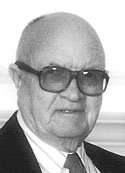
Wally ReedOne of the difficult things about living over seas is how things change back home. It’s not surprising or unexpected because we too are changing, it’s just that some of the changes are harder to deal with than others.

Today, we received our home church’s weekly bulletin from December 11, 2005 and saw the following:

Dr. and Mrs. Griffin Jones and our Church family extend their deepest sympathy to Mrs. Melba Reed, and Mr. Guy Reed in the loss of husband and father, Wally Reed.

In other words, things at home had changed in a way that was sad for me: Wally Reed died on Saturday, December 3, 2005.

However, to say that Wally died can easily give the wrong impression. Wally didn’t die in the sense that he ceased to exist. Rather, Wally was transformed from a well worn, even broken body into the glorious presence of his Lord, Jesus Christ.

Though we had previously met in Israel, my first real opportunity to get to know Wally was on a mission trip to Mexico in 1994. Our church, Temple Baptist, in partnership with a Mexican Bible college, was sponsoring the construction of a church building in a small sugar cane farming village. For a few reasons I counted it my privilege to end up bunking next to Wally and his son Jon. Not only did Wally have a footlocker overflowing with snack goodies, which he freely gave away, but he was a genuinely nice man who was very enjoyable to be around.

Wally laughed easily and had an ability to infect others with the humor of a situation, even if he was the victim of the funny mishap. For example, one of my favorite stories was of Wally getting lost in the Vatican. On their church tour to Israel, the group had a stopover in Rome and during the tour of the Vatican Wally mistakenly got in line behind the wrong group and followed them to the upper levels of the Vatican. Though he admitted to being a bit frightened when he realized his mistake, while re-telling the story he could still laugh about the predicament he had gotten himself in: He couldn’t speak Italian, he didn’t know anyone he found himself surrounded by and, more importantly, the long, narrow, steep staircase he had climbed was starting to take it’s toll on his ability to breathe. As he sat down to rest, he said that he started to think, “I’m going to die at the top of the Vatican, and no one is going to know who I am or what to do with me.”

After his colon surgery, Wally laughingly told me, “Well, I came in here with a colon, now I’m going home with a semi-colon.” He was taking his situation in stride and making a witty, play on words, which revealed not only his sense of humor, but his love of word games as well. Every time I visited Wally, he made sure to show me the puzzle he was currently working on and to tell me the books he had recently read.

The last time I dropped in on Wally and Melba, he was sitting in his recliner, creatively remodeled to accommodate his long frame, wearing an oxygen tube working a crossword puzzle. His mobility had been restricted, though He and Melba were still getting out as much as possible, carrying a portable oxygen tank, but he didn’t complain about the restrictions. He simply took it in stride, apparently realizing that it was simply the result of a lifetime of hard work in a hard industry, and that given all the things he had experienced in life, this was a much better situation than it could have been.

Wally was modest, intelligent, and easy for me to be around; I’m richer for having known him. Thanks for the memories, Wally; I’ll miss you, my friend.

Wally’s obituary can be viewed at the bottom of this page.