Everybody’s Talking About the Resurrection

Since Sunday, April 16, was Easter Sunday, you might not think my title is strange. Perhaps where you are, everybody is talking about the resurrection. However, here in Israel, even on Easter Sunday, everybody isn’t usually talking about the resurrection, unless, of course, you were one of 10,000 people packed into Tel Aviv’s Nokia Arena on Sunday night.

One of the organizers, Yoni Kahana, happily described the evening as “an amazing turnout.” He went on to say that that “Everyone came away with renewed faith in the imminent coming of [the messiah]. He may not have come on Sunday night. But he will truly be revealed any second.” Wow, ten thousand people gathered together in Tel Aviv, Israel excitedly anticipating the return of the messiah. Now that is something that will even get a Baptist to shout “amen,” maybe even clap.

The interesting twist on this, however, is that on this Easter Sunday they weren’t talking about Jesus’ resurrection and imminent return, they were talking about the (hoped for) resurrection of the late Rabbi “Messiah” Menahem Mendel Schneerson, who died in Brooklyn in June 1994.

MessiahThis kind of resurrection talk isn’t new; it’s just different in that it is open and public. In the years since Schneerson’s death, particularly in the days immediately following, many of his followers proclaimed their belief in his identity as Messiah, but it was almost an “in house” discussion. A discussion that, at times, grew to more than a friendly discussion, which threatened to completely split the Chabad movement.
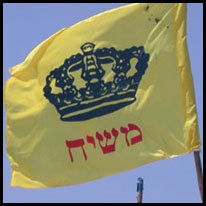
In recent years, though, I have noticed a growing number of posters along the highways proclaiming The Rebbe, as his followers know him, as Messiah. Some are more subtle than others, like the one on the right, for example: On this flag, the word Messiah (in Hebrew) is written under the royal crown. If you don’t have more background information on this campaign, it would be easy to dismiss this as a fervent, religious Jew simply flying his colors.

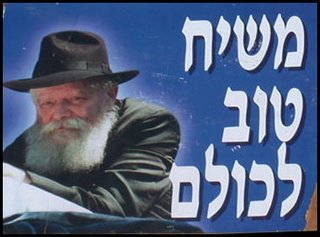
This poster (left), commonly seen all over Israel, King Messiahfits into the less subtle category as it says “King Messiah” under the photo of The Rebbe. I’m not certain that this particular poster was at the convention hall on Sunday night, but the sentiment certainly was. Rabbi Zalman Notik of the Torat Emet Yeshiva in Jerusalem spoke openly of Rabbi Schneerson as the messiah. Furthermore, he supported the missionary zeal for which Chabad has become known when he said, “…the most important mitzvah [commandment] is to publicize the idea that the Rebbe is messiah.” No wonder Chabad is often characterized as the Jewish evangelicals: They believe that Rabbi Schneerson is the messiah and that he is good for everyone, particularly Jews.

A religiously observant, Jewish friend once told me that he didn’t agree with Chabad’s or my desire to tell others about our faith. “I believe” he said “that what I believe is good for me, but not necessarily for everyone else.” I pointed out that that is one major difference between us: I believe that Messiah is not only good for everyone, but necessary. Apparently followers of the Chabad sect of Judaism believe more like I do about messiah in that regard. Our disagreement comes in the identity and function of the messiah, not the desire for others to know about him.

The Messiah is good for everybody.This poster (right) includes with The Rebbe’s photo the words, “Messiah is good for everybody.”
Rabbi Schneerson Quick Facts:
Date of Birth: April18, 1902
Place of Birth: Nikolaiev, Ukraine
Visits to Israel: None
Date of Death: June 12, 1994
Place of Death: New York, USA

Silver and Zahav Part 1

One Means One, Or Does It?

I received some excerpts of a paper by Eliyahoo Silver and Isaac Even Zahav in which they intend to explain why Jews categorically don’t accept the New Testament or Christianity. Unfortunately, I have been unable to acquire the complete 20-page document and only have small excerpts.

Apparently, the authors are no longer circulating their polemical piece, if “they” ever were: I have reasons to doubt their existence as actual people. However, the arguments put forth in their paper are fairly common issues that surface in Jewish Christian dialogues.

I have been asked to respond to their points, and the following is my offering to that end.

According to Silver and Zahav, “The Jewish God is one, as it is written: ‘Hear Israel, Y-H-W-H is our God, Y-H-W-H is one’ (Deut. 6:4). So according to the Bible there is one God, and that one God is one. One means one; not two, not three, not three in one, not two in one, not three divisions of one, but ONE WHOLE ONE ALONE…”

Deuteronomy 6:4 is a great starting point for this discussion because it is so familiar to Jewish people. In fact, it would be hard to underestimate its familiarity. Among Jews, it is commonly offered as the definitive statement on the oneness of God and is known as the “Shema.” Almost every Jewish doorpost is decorated with a small box containing this verse and frequently one can even see cars decorated with bumper stickers displaying the “Shema.” It’s everywhere. Don’t be fooled, though, the fact that this verse is so well known, shouldn’t suggest that everyone understands what it actually says. This is the case regarding Silver and Zahav: Their rendering of Deuteronomy 6:4 is accurate, but misleading because it leaves the reader with the wrong impression. (Their additional commentary is simply wrong.)

The reason I suggest their translation is accurate, yet misleading is because in Hebrew there exists two different words that are translated as the English word “one.” The word “yahid” means an absolute or single one. For example: a steel ball, a rock, or a son. The word “echad” means a composite one. For example: an egg (three parts: shell, white, yolk), an automobile (thousands of parts make one unit), or a cluster of grapes.

The following biblical examples of “yahid” and “echad” help clarify the distinction: Gen 22:2 – “Take now your son, your only (yahid) son, whom you love, Isaac, and go to the land of Moriah. . . “Judges 11:34 – “Now she was his one and only (yahid) child; besides her he had no son or daughter.”Ps 22:20 – “Deliver my soul from the sword, my only (yahid) life from the power of the dog.”Ps 25:16 – “Turn to me and be gracious to me, for I am lonely [alone] (yahid) and afflicted.” Genesis 1:5 – “…there was evening and and there was morning, one (echad) day.”Genesis 2:24 – “For this reason a man shall leave his father and his mother, and be joined to his wife; and they shall become one (echad) flesh.” Ezra 2:64 and Nehemiah 7:66 -“… forty two thousand three hundred and threescore stood as one (echad).”
I will render Deuteronomy 6:4 so you can see what Moses actually wrote: “Hear Israel, Y-H-W-H is our God, Y-H-W-H is ECHAD.”

If God wanted to communicate that “one means one; not two, not three, not three in one, not two in one, not three divisions of one, but ONE WHOLE ONE ALONE…” then it seems that He would have used the word “yahid” and NOT “echad”.

God chose “echad” because He wanted to communicate that His oneness includes the unity of His composite. We learn from a survey of the Jewish Bible [Old Testament] that God presents Himself in three persons: God you can not see face to face and live, God you can see face to face and live, and the Spirit of God. Christians refer to this as the Trinity.

To be continued…

Got Milk?

The old adage, “there’s no need to cry over spilled milk,” is probably fairly accurate. However, my experience today, was begging me to cry over spilled milk.

This afternoon, as we were ending an eventful grocery shopping experience (we have a rowdy 2 year old) at the cashier, I noticed the line wasn’t moving: The cashier had for some unannounced reason wandered down to the customer service desk. Finally, she returned and as she was putting the finishing touches on the current customer’s transaction, the customer in front of me allowed a friend with a handful of groceries to cut in line from the opposite direction. Now that I replay that event in my mind, I realize they had conspired the whole thing while waiting for the wayward cashier to return.

In an effort to divert everyone’s attention from his obvious selfishness, as the cashier was waiting for the register to finish its tally of his goods, he turned away from her and started waxing eloquent about nothing with his accomplice, the guy in line ahead of me.

Almost immediately, the register indicated the amount due, which the cashier dutifully repeated in his direction. He wasn’t listening: By chatting up his accomplice, he was avoiding the white elephant in the line – his own presumptuous self-importance. The cashier waited. I waited. Mr. Rude ignored her and avoided making eye contact with me. He knew I was staring at him. She waited. He continued talking. She continued waiting. Eventually, enough was enough. Actually, enough was more than enough and I gently (really) asked if he wouldn’t mind paying, and then I offered a reminder that he had already cut in line. Realizing the charade had been unsuccessful, he said, “you’re right,” paid the cashier and disappeared.

Now that Mr. More-Important-Than-Everyone-Else had finally moved along, so should the line, I thought. And the line was starting to move forward until IT happened. From deep within the mountain of groceries that were resting on the conveyor belt came a trickle…of chocolate milk. A jug of milk had sprung a leak, apparently from being crushed under too much weight.

From the reaction of the cashier, an uninitiated person might have thought toxins were seeping out of Grocery Mountain and expected her to call the haz-mat team. She hopped up from her stool [1], covered the electronic eye that automatically advances the belt with her left hand and reached for her roll of toilet paper [2] with her right hand. All this was done in one motion with the grace of an Olympic gymnast. Nice performance, definitely deserving of high marks.

When the customer realized what was happening, he tried to help by removing any items that had been touched by the offending milk. “Stop! Stop!” she exclaimed, “You’re making it worse for me.” Clearly, she didn’t want the milk to flow further down the belt and into the motor, but she was more concerned that the milk NOT leave residue that might contaminate groceries belonging to future customers. So, she dutifully cleaned each item, making sure there was no milk left behind. One by one, she wiped them all.

In Israel, milk poses a different problem than say soft drinks or juices. Yes, soft drinks and juices will ruin an electric motor the same way chocolate milk will, but they don’t create kosher problems like milk can.

In Jewish dietary laws, it is forbidden to mix meat and milk products. This principle is loosely based on the biblical prohibition against “boiling a kid in its mother’s milk,” which is found 3 times in the Jewish Bible – commonly referred to as the Old Testament (Exodus 23:19, 34:26, and Deuteronomy 14:21). I say loosely, because the Bible clearly does not forbid mixing milk and meat. However, the rabbinical authorities have determined the safest course is to forbid all mixing of milk and meat. The result is a distinction between meat restaurants and dairy restaurants; meat dishes and utensils and dairy dishes and utensils in religious homes; and panic in the supermarket if milk spills.

The potential problem of mixing meat and milk in this way was only theoretical since all the meats in the store are sealed in plastic. However, if some loose milk were to be carried into someone’s kosher kitchen and contact some meat, a theoretical problem would become a very real problem. This cashier was not taking any chances with theoretical or real problems. We would just have to wait for her to fix the situation; and wait we did.

Got milk? If so, don’t spill it.

[1] In Israel, grocery store cashiers sit while they work.
[2] For some reason, all store clerks in Israel use toilet paper to clean the counters and glass. Why they don’t use more sturdy paper towels is a mystery.