Well,…once again, Messianic Jews are stirring things up in Israel.
It’s not enough that they’ve been in the news because their services have been disrupted and property damaged by Orthodox Jewish protesters as happened in Beersheva. Or that their leaders have been assaulted by Orthodox Jewish protesters and then put under house arrest by the police, making them a double victim, as happened in Arad. Or that one of their children almost lost his life when he opened a bomb disguised as a holiday gift as happened in Ariel. Or that one of their congregations was evicted from a secular kibbutz due to pressure from the Orthodox Jewish Establishment (OJE) as happened in Jerusalem.
Now, an 11th grader from Pisgat Ze’ev (a northern suburb of Jerusalem) has gone and qualified as one of four finalists in the International Bible Quiz (aka the “Global Bible Quiz for Jewish Youth”) and caused the OJE to get into a tizzy, demanding that all “Jews” boycott the event if she is not disqualified. What’s the reason she should be disqualified, you ask. It’s not because she was discovered to have cheated her way to the championship. She wasn’t, and she didn’t. It’s not because she admitted to being an atheist and believes the Bible is full of lies and fairy tells. She didn’t, and it’s not. Her offense: She’s a messianic Jew that believes Jesus is the Messiah.
Ironically, had atheism been her identity, there would be no issue raised by the OJE. That’s still a dilemma that the OJE has yet to resolve: How can an atheist be considered Jewish? Some respond that being Jewish is cultural. Okay, if that’s the case then this student’s “religious” beliefs should be of no consequence. Right? Right! And that brings us back to the dilemma: Who is a Jew? Is being Jewish a cultural issue? A linguistic issue? A religious issue? A national issue? And this is where in their inconsistency, the OJE has painted themselves into a corner. And they are inconsistent because their agenda is to delegitimize Jews who believe Jesus is the Messiah.
By the way, the name of the state school Bible quiz champion is Bat-El Levi, the daughter of Ruti and Yitzhak Levi. Kol HaKavod, Bat-El.
Those who are interested in this type of event can read the complete story in this Jerusalem Post article. I would encourage you to survey the reader comments, too.
 Since Passover starts Saturday night immediately following the end of the sabbath, the last efforts to rid the home of leaven are underway throughout the country. Most people have been cleaning their homes for the last several days, and the last ritual is to gather the final bit of leaven and take it outside to be burned. In the first photo below, you can see the bread that our neighbors were burning.


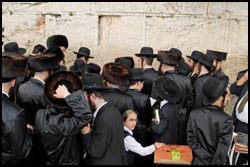 Due to the personal nature of prayer, even at a large public venue, I try to be discreet in taking photographs at The Wall. I realize that some people don’t want their picture taken at all, while others, for the sake of public appearance, pretend to not want their pictures taken. Others don’t mind at all, and sometimes even ask to have their picture taken. I ran into such a situation on my last photo shoot at The Wall: some wanted me to take pictures, others didn’t.
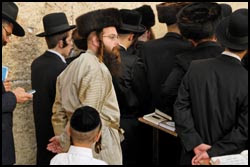 Suddenly from behind me on the right a wave of men dressed in the standard issue black and white uniform flowed toward The Wall in a way I had never seen before. In the front of that wave of people was an elderly man whom I could tell was the reason for the crowd and the anxiety. The crowd that was already at The Wall opened up to allow this apparently holy man to approach The Wall in the way I envision the Red Sea opening up to allow Moses and the children of Israel to pass. As soon as I saw the wave of people moving in from my right, I got to my feet and tried to position myself for some good shots of whatever it was that was happening. But I was too late because just as quickly as the wall of people opened, it closed, and the special guest was sealed inside, safely within the admiration of his followers and protected from people like me.
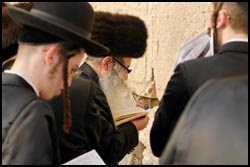 The crowd continued to swell as word of the man’s arrival spread. I could feel myself being pushed further and further away from the guest of honor, but I was determined to find an open view of that man, whoever he was. I moved around the mob, first left, then right, looking for a view. Finally, on the far right, I was able to weave my way in front of some of the more timid onlookers and see him, face close to the wall, prayer book in hand, moving back and forth as he prayed.
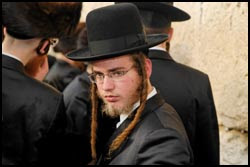 Perhaps the most interesting thing in the whole process, was that a group of teenagers had made their way close to the elderly man and were serving, for lack of a better word, as his posse. It seemed that their responsibility was to keep people like me at a distance, or at least block my view. And once they saw me raise my camera, they went into action. They never approached me, they simply crowded together in a way that blocked my view. Well, most of the time. They were in a dilemma: should they give more attention to me, or to praying with their leader? So, as they bobbed back and forth in prayer, occasionally looking back over their shoulders as a warning to me, they occasionally gave me clear views of The Man.
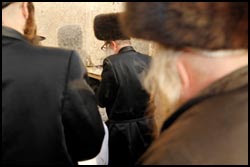 As I sat thinking about that brief conversation, another of the “Holy Man’s” admirers approached me. However, unlike the previous fan of The Man, with a big smile on his face the second man asked, “Did you get some good pictures of him?” “Yes,” I answered. “Do you know who He is?” “No, perhaps you can tell me,” I offered. “He’s a very famous teacher. Do you think you got some good pictures?” “Yes,” I assured him. “Well, if you got some good pictures, would you send me a couple? You should try to get some more. Try from the other side and send those to me, too.” I entered my phone number in his mobile phone so that he could give me an address because neither of us had a pen or paper. He seemed really happy at the prospects of getting some photos of the “Holy Man” praying at The Wall at Passover. However, he never called. So, I guess if he reads this, he can see some of the photos he missed.