The Day After: Beware

I can’t think I would need to remind ANYONE that a certain man/Bible teacher/prophet (or whatever he actually is) predicted specific end times events would occur yesterday. And, in the aftermath of none of them coming to pass, I want to offer a word of caution to those born again Christians who have been or are starting to scoff at this man and his prediction(s) . . . and end time events.

It’s a fine line between mocking him and ending up mocking the rapture of the saints or the Lord’s return, whichever you happen to have understood him to be predicting. As May 21, 2011 approached, I watched many Christians blog/tweet/comment to the effect that “the Bible teaches that we can’t know, so this guy is a crackpot for saying so dogmatically that he knows the day . . . and this isn’t the first time he’s done this!” That’s all well and good, but we need to be careful that we don’t begin to mock the events themselves.

I found some of the bloggers and tweeters following the deadline as it moved through the various timezones easily crossing the line to essentially say, “See, I knew it wouldn’t happen today. Today is just like yesterday, which was just like the day before.” That kind of blogging/tweeting is very close to “Where is the promise of His coming? For ever since the fathers fell asleep, all continues just as it was from the beginning of creation. (2 Peter 3:4 NASB)”

And we don’t get a free pass to mock because a “crackpot” has predicted a certain day. Neither do we get a pass to believe that nothing can happen today because someone predicted this date. The Lord’s hand isn’t stopped because someone disobediently or incorrectly issued a time line.

In reverse order: the scriptures encourage us to look expectantly for the coming of the day of God (2 Peter 3:11-13), not be ignorant that the “slowness” of God’s promise is actually a sign of God’s patience toward us (3:8-9), and beware that scoffers will arise in the last day questioning the Lord’s coming (3:3-4).

So, in these days after, let’s please be careful that we don’t follow the path of scoffers regarding God’s promises just because someone did what they weren’t supposed to do.

We ID

We ID! That’s a logo and a mantra at many convenience stores in our area, which is intended to tell minors they can’t buy tobacco or alcohol. Here’s a story from Fort Worth about a liquor store that allegedly sold vodka to an underage patron that ended very badly.

In the story, the owner of the store says that he recently made a mistake and didn’t ID an underage buyer that had been sent in a sting operation. But, he explains, “I was so tired and exhausted and I wasn’t even paying attention” before assuring the readers: “I check IDs, and if they’re too young, they aren’t getting anything.”

I don’t know what the protocol for ID-ing an alcohol buyer is supposed to be, but a couple days ago, at the Walmart in Odessa, two men clearly in their 60’s got carded before they could purchase two large cases of beer.

They were in line behind me, so I was already walking away when I heard the clerk ask both for identification: “Since you are together, I have to see ID from both of you,” she said. I didn’t think I heard her right since I was already walking away and they were both obviously old enough to be AARP members. But, I hesitated long enough to see both of them present their driver’s licenses. One actually gave me a sly grin as I turned to leave. I wanted to verify their ages at the door, but thought I better mind my own business.

If a manager from the east Odessa Walmart reads this, you can be sure that at least one checker does ID those buying alcohol . . .  even if they obviously aren’t minors.

I’m guessing this is part of the zero tolerance movement that sets certain rules that eliminate judgment on the part of those in authority. In this case, the clerk apparently doesn’t have to make any determination . . . just ask EVERYBODY for ID. Maybe it’s better this way for alcohol purchases, but I’m afraid zero tolerance policies generally dumb down society and end up hurting people along the way. Usually, the stories of zero tolerance lunacy come from elementary schools, but I think I’ve found one here, too.
Crucifixion Friday in the Old City

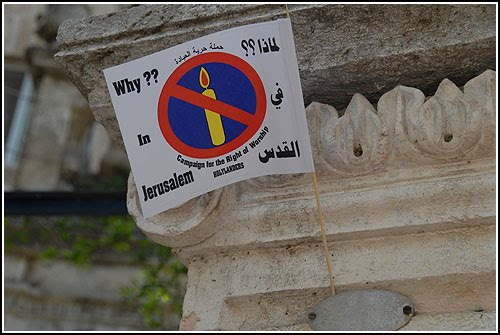
Many Christians from around the world were expected to flood the city for Good Friday, and they did. In fact, since Passover and Eastern and Western Easter falls on the same weekend this year, the city seemed particularly crowded. In expectation of the large crowds the Israeli government implemented new access procedures at the Church of the Holy Sepulchre, which created a lot of tensions. Flags like the one below could be seen throughout the Christian Quarter.

The flag is aimed at the Israeli authority’s efforts to control the crowds, which at times ended up communicating to those wanting to be near or inside the church that they were not allowed to worship. Obviously, once the new arrangements were announced, someone(s) went into action to highlight the Israeli actions and paint them as negatively as possible. However, being in the area today, I must admit, one could easily get a very negative impression without the presence of the flags.

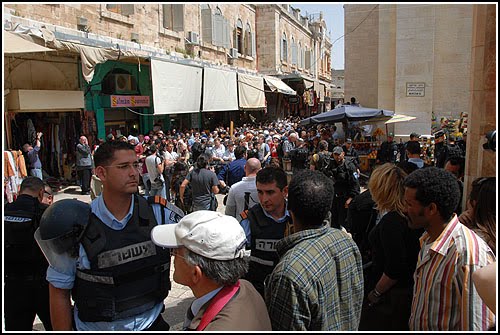
Here are the police controlling access to the church:

The police were standing behind barricades, allowing people to enter in very small numbers. At one point, tensions were so high that the riot police were called in:

I was told that things escalated to the point of blows being exchanged. I did not see that, but I have no reason to doubt it.

It seems to me that the Israelis are in a no win situation here: If they don’t control the crowds, there is a real possibility of a stampede or worse, and they will be accused of shirking their responsibility for public safety. If they do control the crowds, they are accused of preventing pilgrims from worshiping. 

History indicates that during times like these, the various Christian groups that have authority within the church facility can’t manage to get along without violence, so I’m not sure what I would advise them to do.

You May Feel Underdressed if . . .

. . . you come to tour the Holy Land without your Jesus clothes.

Question: Do we really honor the Lord Jesus by wearing a “likeness” of him on our clothes and sitting on that “likeness” as we ride in a bus all day? 

The Holy Land’s Underbelly

On Wednesday evenings, my friend Bill and I go to Tel Aviv to teach at the Sudanese church, which is located near the central bus station in south Tel Aviv. This an area that is heavily populated by foreigners – some legal, some illegal.

One Israeli described the demographics like this: “It’s so crowded with foreigners that it’s hard to find an actual Israeli there. And if you do, they are simply passing through going to or from the bus station.” His observations are pretty accurate. After our meeting with the Sudanese men, we generally get a bite to eat at the nearby pedestrian mall. Besides eating, we also wander around trying to strike up conversations with whomever we can; but mostly we are observing, trying to figure out how things work in this island of foreign workers.

Not only is this the foreign workers’ stomping ground, it is also an area with homeless people who have found themselves on the streets due to drug abuse or mental illness. I’m sure there may be some other reasons, but those seem to be the most prominent.

The homeless guys in the photo above, are sleeping in the shooting gallery. That’s where heroin addicts hide in the shadows and inject themselves  (see the video below). The place is littered with filth, all the things associated with homeless drug addicts: human waste, trash, treasures collected from dumpsters, rats, empty lighters, spoons, and old needles and syringes.

At times it’s overwhelming to see the collection of misery that has settled in that area. And, I’m talking about the majority of those in the area, not just the heroin addicts sleeping in their own waste. My heart aches both for the addicts and for those who have made their way to Tel Aviv – however they did that – to work one level above slave conditions (worse in some cases) in an effort to send some money back home, or to seek a better life for themselves.

What’s astounding is the emptiness and collective hopelessness that permeates the area. Pubs of one ethnic variety or another are the gathering places, the anesthesia that dulls the emptiness that is life for so many of these wanderers.

In contrast to this painful scene, are the men who meet us to study God’s word at the Sudanese church a couple streets over. They, too, have tales of hardship to tell, but they aren’t empty or hopeless. The difference? It isn’t in the hardship of their lives verses the hardship of those we painfully observe on the walkway each week, because their lives are equally challenging. The real difference is the hope of the gospel.

I’m encouraged every Wednesday night to sit with these men and see a real example of the hope and contentment the gospel offers; to see the effects of believing in the supremacy of Christ over all other suitors.

Here’s a video of two guys shooting heroin in the shooting gallery last night.

UPDATE: Here’s the same video with brightness and contrast adjustments: