
Craig Dunning, Oak Cliff Mustangs, 1975
I had a two-season venture into youth football in 1975 and 1976. I wasn’t so much into football – I was always a baseball guy – but so many of my baseball teammates talked about playing football that I thought I would give it a try.
Most of the talk among my friends was about the Oak Cliff Mustangs, so that was the team I tried out for.
The Mustangs were considered to be one of the best youth football clubs in Dallas in those days (the Jets organization was the other, as I remember it). Therefore, many of the better youth football players chose the Mustangs because of their winning reputation. The odds were stacked against me because the challenge of competing for a roster spot with some of the best football players in Dallas was compounded by my small size and lack of experience. The only thing I brought to the table was effort; I desperately wanted to make the team. Not just any team. This. Team.
The tryout period was rough; it was hot, the practices were long, I had no idea what I was doing, and I didn’t particularly like getting crushed by the bigger, more experienced players. We practiced daily (M-F) from 6-8pm at the north end of Redbird Park, which is now known as Thurgood Marshall Park.
The head coach’s name was Ray Dean. He was old, stern, and ran a tight ship. We had other coaches, but I only remember him and his son (1976), whose name was Kit or Kip.

Craig Dunning, Oak Cliff Mustangs, 1976
Tryouts were about 2 weeks long. Maybe longer, and definitely shorter for some! I think I have blocked the specifics of tryouts from my memory to preserve my sanity and dignity. The warm up routine was 3 laps around the field (about 1/2 mile) followed by calesthenics. For calesthinics, a couple players, chosen by Coach Dean, led us through a standard set of jumping jacks, sit ups, neck rolls, etc.
After we were sufficiently warmed and stretched, we went through a variety of skills and coordination drills, which were followed by full-contact and blocking pad drills. I did fine in the skills and coordination sessions, but routinely got smothered in the blocking and contact events.
The best part of practice – besides the end! – was scrimmaging. Even though it was stressful because I didn’t know what I was doing at any position they placed me, I most enjoyed scrimmage. To end practice, we did sprints or laps or both. I. Hated. That. Part.
The final thing each night of tryouts was the cut. I dreaded the thought of being called to the “gallows,” but pretty much expected it. Each night, my dad sat in a lawn chair with the other parents watching practice and waiting for the evening to end with the inevitable summons to meet with Coach Dean. After each practice, Dad always inquired: “He didn’t tell you to stay after?” Surprisingly, that didn’t happen the first week. It should have, but it didn’t. And more surprisingly, it didn’t happen the second week, either. I actually made the team! But not because of any skills or potential. I didn’t have either. According to Coach Dean, I had earned his respect and a spot on the roster because he tried but couldn’t make me quit. (Story continues below.)
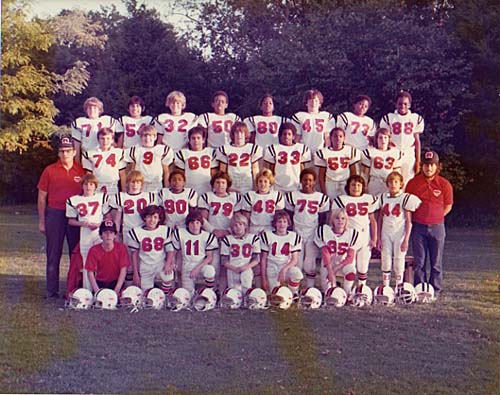
1976 Oak Cliff Mustangs
At the year-end banquet, Coach Dean awarded me the Heart Award, which was 10 silver dollars and a handshake. More important to me, though, is what he said when announcing the award:
The recipient of the Heart Award shouldn’t be here tonight. He should not have made the team; by all accounts, he wasn’t supposed to. At tryouts, he was the smallest, slowest, and least qualified player in the bunch. But, he wouldn’t quit. He came in last on sprints. But, he wouldn’t quit. He shuffled along at the back of the pack on laps. And when I made him run more laps for being last, he ran them … slowly, but he refused to quit. He was easily knocked down. But he always got back up. I wanted him to quit, but he wouldn’t. I tried every way I could to get him to quit. But, he wouldn’t. And because he wouldn’t quit, I kept him on the team.
Ladies and Gentlemen, the recipient of the the Heart Award is Craig Dunning.
For two seasons, I didn’t quit. For two seasons, I went to practice every day Monday thru Friday, then to games on Saturdays. I rarely got to play in the games. It didn’t matter if I sat on the bench near the coach or stayed out of his way, I wasn’t getting into the game until mop-up time, if at all. Sometimes that meant less than 01:00 remaining on the clock. Many times I never entered the game at all. Only a few times in two seasons, did I get into a game when the outcome wasn’t yet decided. On one of those occasions, an away game against the Grand Prairie Packers, I made the most of my opportunity: I sacked the quarterback twice on consecutive plays. (Story continues below.)

In this undated photo, Craig Dunning (20) pursues an opponent. This may be the only existing photo of Dunning in action on a football field.
I know it was hard on my parents to see me work so hard and get seemingly so little out of it. There was a financial cost for them, to be sure. But, there must have been an emotional cost, as well. Yet, they never complained in my presence of either. They were team players. I appreciate their willingness to let me fight and struggle and hurt in this way, so that I could be part of something bigger than myself. I had made the roster of one of the best youth football teams in Dallas, Texas. I was an Oak Cliff Mustang! That was important to me. Thus, it was important to them and they willingly paid their own price for that to happen.
I learned much about life in those two years. I learned the value of getting up when I got knocked down. I learned the value of putting one foot in front of the other and continuing to move forward, even slowly if that’s all I have left in me. I learned the value of being part of something bigger than myself. I learned about team dynamics and team work. I learned the value of suffering. I learned the taste of victory and defeat. I learned what it feels like to be unappreciated. I learned what it feels like to sit the bench. I learned how to earn respect.
Thank you, mom and dad. Thank you, Ray Dean. Thank you, Oak Cliff Mustangs 1975 and 1976.


